Snakes and Ladders
 Linkedin
 Google +
Ups and downs in China-U.S. relations run through 2019
China-U.S. relations have been on a roller coaster ride through 2019. The U.S.-initiated trade war escalated earlier in the year as additional tariffs were levied. Several rounds of negotiations were held. After going through up and downs, the two countries approached a ceasefire at the end of the 13th round of talks in October. In December, they announced they had agreed on the first phase of a trade deal.
According to the agreement reached in December, China will buy more agricultural products from the U.S., and the U.S. will fulfill its commitments to cancel some of its additional tariffs on Chinese products. China also suspended the planned additional tariffs on some U.S. products, originally scheduled to be implemented on December 15.
The trade war has hit the U.S. economy, with stock market risks and inflationary pressures mounting. The export markets for agricultural products and semiconductors have shrunk. If the trade frictions are further prolonged, they will aggravate U.S. problems such as domestic debts and unemployment.
In the first 10 months of 2019, bilateral trade fell 10.6 percent year on year. The ASEAN has overtaken the U.S. as China’s second largest trading partner. China’s direct investment in the U.S. has plummeted by 90 percent since Donald Trump took office, said a report by the Rhodium Group, a U.S. research provider.
But despite the U.S. Government’s measures, U.S. companies’ investment in China has not declined. On the contrary, they are still increasing their capital, mainly in automobile, retail and some hi-tech industries. According to Rhodium, U.S. direct investment in China was $6.8 billion in the first half of 2019, 1.5 percent higher than the average of the past two years. It showed that Trump’s policies to bring manufacturing back to the U.S. were not effective. At the same time, encouraged by China’s efforts to deepen reform and expand its financial market, U.S. enterprises still hold a positive outlook on the Chinese market.
From trade to tech
The technology war by the Trump administration is also escalating. The U.S. Department of Commerce announced in May that it would add Huawei Technologies and several of its affiliates to the Entity List, restricting U.S. firms from doing business with these companies.
In November, the Federal Communications Commission banned U.S. telecommunication service providers from using federal subsidies to purchase equipment or services from Huawei and ZTE Corp. More Chinese hi-tech companies in areas such as artificial intelligence, drones, facial recognition and security monitoring are also being targeted.
One result of this is that China has become more determined to fast forward domestic research and development to reduce its reliance on U.S. technology and components. The technology war against China is being opposed by the semiconductor businesses in the U.S. and some U.S. allies, since it is forcing them to abandon their huge market in China. The government hasn’t been able to provide them effective alternatives.
The negative impact of the frictions has spread to other areas. The U.S. trade hegemony and bullying have changed Chinese public’s opinion of the U.S. The U.S. measures to tighten visa policies for Chinese scholars and students and strengthen surveillance on them have hindered normal exchanges between the two peoples.
However, these are merely symptoms of mounting tension between the two countries. The real cause is the strategic adjustment of the U.S. Since the release of the new U.S. national security strategy at the end of 2017, the strategic framework of the Trump administration’s policies to compete with China has gradually taken shape.
-
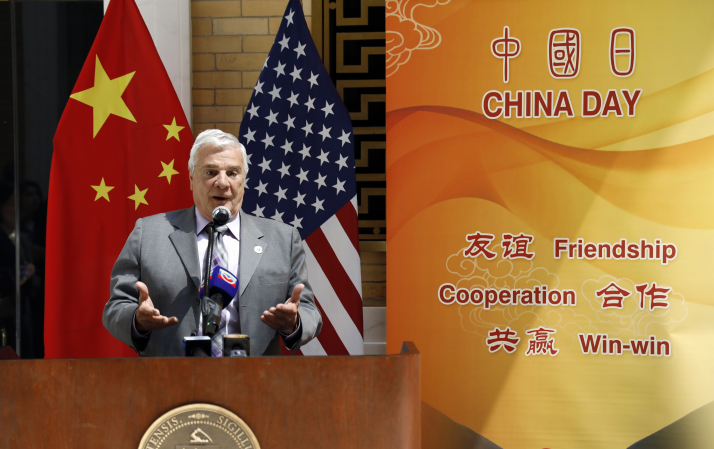
Paul Donato, a member of the Massachusetts House of Representatives, speaks at the China Day event held in Boston on August 15 (XINHUA) -
The strategy specter
In mid-2019, the U.S. launched the Indo-Pacific Strategy to strengthen military deployment across the Indian Ocean and the Pacific Ocean. It aims to create a geographical fulcrum; enhance security cooperation with Japan, India and Australia; and hedge the Belt and Road Initiative. The U.S. military has been conducting more frequent, high-profile and provocative reconnaissance in the South China Sea, the Taiwan Straits and the East China Sea. It has also been more brazen in its efforts to develop substantive contacts with China’s Taiwan.
After withdrawing from the Intermediate-Range Nuclear Forces Treaty with the Soviet Union, the U.S. has started promoting new and broader nuclear arms control and disarmament negotiations, demanding China’s participation in them. It has also begun to upgrade its anti-missile system and deploy new medium-range missiles around China. The intention seems to be to probe China’s military equipment and curb the development of China’s capabilities in nuclear missiles, cyber space, artificial intelligence and other emerging fields.
U.S. Vice President Mike Pence and Secretary of State Mike Pompeo have spoken negatively about China in public. U.S. interference in China’s internal affairs such as Hong Kong- and Xinjiang Uygur Autonomous Region-related issues smacks of efforts to provoke a “color revolution” in China. The right wing on Capitol Hill closely interacted with the hawks in the executive branch to renew or pass a series of congressional legislation, including a bill reaffirming the U.S. “commitment” to Taiwan, a so-called Uygur Human Rights Policy Act and a Hong Kong Human Rights and Democracy Act.
The Trump administration’s overly aggressive policy toward China has seen protests from reputed U.S. figures. Some of them recently wrote an open letter to Trump saying that “making China a U.S. enemy is counterproductive.”
There is widespread concern in the international community as well. While addressing the 74th Session of the UN General Assembly, UN Secretary General António Guterres expressed his fear of the world splitting into two, with the two largest economies on Earth creating two separate and competing worlds.
Global implications
China remains aware of the dangers of such a situation. At the China-U.S. leaders’ meeting on the sidelines of the Group of 20 Summit in Osaka, Japan in June, Chinese President Xi Jinping stressed that despite the great changes in the international situation and China-U.S. relations during the past 40 years, “one basic fact remains unchanged: China and the United States both benefit from cooperation and lose in confrontation.” Both he and Trump agreed to jointly advance a China-U.S. relationship featuring coordination, cooperation and stability.
At a press conference on December 13, Chinese officials said the world’s two largest economies must handle bilateral economic and trade relations with the big picture in mind. Reaching an agreement would serve the fundamental interests of the people of the two countries and the world.
China will also face post-election complications. The battle between Republicans and Democrats during the 2020 presidential election in the U.S. might impact U.S. policy on China. There is a cross-government and cross-party consensus that China’s rise must be fully addressed. In the future, whoever wins the election might substantialize a new U.S. strategy toward China. The far right, who are still in control of some government departments, might push for more concrete measures to contain China and mar China-U.S. relations.
A successful compromise is that while defending national interests, both sides avoid vicious competition or all-out confrontation. Areas with high risks of conflict such as military confrontation in the South China Sea and cyber security need to be carefully managed by both sides. They should avoid prolonged trade frictions or an arms race; and they should strive for a broad consensus to benefit all.
Ironically, this year marks the 40th anniversary of normalization of ties between China and the U.S. Henry Kissinger, former U.S. Secretary of State who played a key role in the rapprochement in the 1970s, met Chinese State Councilor and Foreign Minister Wang Yi on the sidelines of the 74th UN General Assembly in New York in September. U.S.-China relations are important to world peace and prosperity, the 93-year-old emphasized. It’s impossible for the two countries to decouple from each other or to avoid each other.