Nicolas Chapuis: A Witness to the Evolution of the Chinese Society
 Facebook
 Twitter
 Linkedin
 Google +
Chinese society has undoubtedly been transformed in the space of two generations: it has become more urban, more affluent, more educated, more open to the world, and fond of consumption and technology.
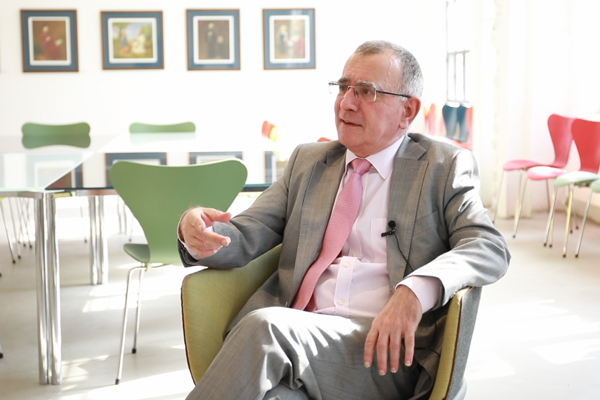
Editor’s Note: Nicolas Chapuis, the European Union’s ambassador to China, has served several tours of duty as a diplomat in China. Mr. Chapuis is fluent in Mandarin and has good knowledge of Chinese culture, allowing him to take a more objective and in-depth perspective towards the country and Sino-European relations. In a recent interview with Beijing Review, he brings us diplomatic and cultural insights into the evolution of Chinese society. Authorized by Beijing Review, the excerpts of the interview is published by China Focus.
This is your sixth tour of duty working in China since 1979. Having witnessed the evolution of the Chinese society over the past four decades, what are the most remarkable aspects of social progress that have caught your eye??
Nicolas Chapuis: Chinese society has undoubtedly been transformed in the space of two generations: it has become more urban, more affluent, more educated, more open to the world, and fond of consumption and technology. Even in the relatively less developed provinces, this opening-up has led to significant wealth in urban centers and the eradication of extreme poverty in rural areas.
What has struck me most over the past forty years, however, is the speed and scale of the intellectual opening-up that has accompanied economic opening-up. In hindsight, the “emancipation of minds” advocated by Deng Xiaoping in the 1980s was the catalyst for the change we see now. The revival of Chinese intellectual production in all fields of knowledge was one of the major events at the dawn of this century. It may not yet be sufficiently appreciated outside China, but the fact is that modern Chinese thought is flourishing. I could cite as an example the remarkable anthology Thinking in China, which was published this February in France under the direction of Anne Cheng, as well as the English translation of historian Ge Zhaoguang’s famous book What is China?
I could also mention the boom in plastic arts, cinema, theatre or even television shows such as The Longest Day in Chang’an, which left a mark on the Chinese-speaking world in 2019 through its aesthetics, its film editing and the quality of its script.
My hope is that this synchronous economic and intellectual evolution will lead to further rapprochement between China and the rest of the world. Europeans have long been curious about things from China, while also eager to engage in exchanges in the field of ideas and culture in general. The economy, however important and decisive, is only an instrument of progress; its object is the emancipation of humanity.
As a diplomat and Sinologist, how does your knowledge of China help you in your work to better understand the Chinese concept of development?
Nicolas Chapuis: Diplomacy in essence is about building bridges of understanding and creating the conditions for productive exchanges between peoples. Knowing the language and civilization of one’s country of residence is naturally an asset anywhere in the world; in China, my ability as a diplomat to converse with others without the filter of translation and my familiarity with Chinese history have enabled me, over the years, to go beyond prejudices or clichés and to dive ever deeper into the complexity of the issues facing China.
On the notion of development, I don’t think there is a specific Chinese concept. We all share the sustainable development goals set by the United Nations in its 2030 agenda. For more than 40 years, international financial institutions have made massive investments in China, with results that are clear for all to see. European assistance has also been considerable, especially in the fields of education, law, and now in the environment and the fight against climate change.
What is unique to China is the extraordinary mobilization of its human resources in quest of the modernization that eluded the country in the mid-nineteenth century. I refer you here to The Search for Modern China, a book by the British author Jonathan Spence.
Global challenges – public health, sustainable agriculture, environment, climate change, cyberspace – require concerted efforts by all nations. Given its weight in the world economy, China has a responsibility that goes well beyond its own development. I hope that, given its traditional commitment to the symbiotic relationship between man and nature, China will be in a position to contribute effectively and voluntarily to initiatives decided in multilateral forums.
You have stressed the importance of continuity in Sinological research and of avoiding compartmentalization. What advice do you have for Chinese and Western researchers in this area?
Nicolas Chapuis: The boundaries of academic disciplines are sometimes artificial: while they are necessary to focus research in a specific field that requires particular expertise, they do not preclude a humanistic approach that seeks to encompass different types of knowledge in order to arrive at a global vision that takes into account the complexities of the real world. In the case of China, the division between classical and modern China, which is obvious, does not seem to me to be always relevant in understanding the key elements of Chinese political thought.
Which Chinese poets or writers do you think are the most important for understanding the Chinese psyche?
Nicolas Chapuis: There are too many of them to be all mentioned. Speaking in very broad terms, I think that any approach to China requires a reading of the philosophers (Confucius, Mencius and Laozi), the great novels (Water Margin, Romance of the Three Kingdoms, Dream of the Red Chamber, Journey to the West), and finally contemporary authors (Lu Xun, Mo Yan, Ba Jin, Mao Dun, Lao She, Qian Zhongshu and Yang Jiang). For the past forty years, there has also been a generation of expatriate Chinese authors who have contributed to the dissemination of their native culture: I am thinking in particular of Fran?ois Cheng, Shan Sa, Dai Sijie and Gao Xingjian in France. Their ability to express themselves directly in French has greatly reduced the original cultural gap.
You have been translating Du Fu’s poems for a long time. In your opinion, can Du Fu help foreigners better understand Chinese people?
Nicolas Chapuis: There is no more essential gateway to a foreign culture than poetry, because of the effect it has on language, musicality, images and feelings. In China, Du Fu has been considered since the Song Dynasty the greatest of the Chinese lyric poets, and yet he was for a long time the least translated, probably because of the difficulty of his texts. In Europe, we also have comparable figures, with poets such as Victor Hugo in France, Dante in Italy and Shakespeare in the UK, who were alchemists of their respective languages and created cultural references that remain relevant today. So, just as it is difficult to understand France without reading Hugo, I believe that reading Du Fu is essential to understanding China.
President Xi Jinping has emphasized cultural confidence on several occasions. Has it been achieved today? What is its role in China’s development?
Nicolas Chapuis: All peoples are attached to their culture, and cultural diversity is certainly one of the most distinctive qualities of humanity. In Europe, national cultures, based on language and history, and bearers of values and identities, converge into a European culture distinct from the other large contemporary civilizational groups. In China, I understand the idea of restoring “self-confidence” and the role that traditional Chinese culture plays in it. What is essential, in my view, is the ability of every cultural area to communicate and engage in dialogue with others. Development is the result of this constant cross-pollination of cultures among one another; self-isolation is historically linked to decline.