Innovation in Orbit
 Facebook
 Twitter
 Linkedin
 Google +

Space breeding is leading the charge in transforming traditional agriculture and pushing the boundaries of innovation and modernization.
By sending seeds on short trips into space, China is developing new crop varieties, contributing to the advancement of agricultural science and bolstering food security.
This process, known as space breeding, exposes seeds to cosmic radiation, which mutates their genes and leads to the creation of new varieties with greater diversity.
Since China’s first space breeding experiment in August 1987, the country has sent seeds from thousands of plant species into space using retrievable satellites and spacecraft. This has resulted in the development of nearly 1,000 new plant varieties, including grains, vegetables and fruits.
The technology reportedly helps increase China’s annual grain production by 2 million tons and produces direct economic benefits exceeding 100 billion yuan ($14 billion).
Why send seeds into space?
Compared to traditional plant breeding techniques, one major advantage of space breeding is its ability to produce germplasm resources with enhanced traits in a relatively short period of time.
Gene mutation is a common and natural process that has driven evolution for billions of years and facilitated the selective breeding of domestic plants and animals for millennia. However, exposing seeds to the higher levels of solar and cosmic radiation that exist outside Earth’s atmosphere increases the rate of this mutation, producing new varieties more quickly.
While these gene disruptions can lead to both positive and negative mutations, space environments tend to favor useful genetic variations. Scientists can grow and test these new varieties and select the ones with the most desirable traits, such as pest and disease resistance, high yields, greater nutritional value and suitability for different growing conditions. Additionally, space offers a clean?environment free from air or chemical pollution.

Seeds sent into space remain there for anywhere from a few days to several months. The seeds selected for these journeys are already genetically stable and exhibit desirable traits. The low-gravity environment also affects seeds, with plants grown in microgravity showing changes in cell shape and the organization of their internal structures.
Chinese scientists have produced space-bred rice, corn, soybeans, alfalfa, watermelons, tomatoes, sweet peppers and more over the past decades.
For food security
Food security is a critical aspect of national security. As a highly populous nation, China has an enormous demand for food, and it is essential to address the challenge of feeding over 1.4 billion people, roughly 18 percent of the global total, with only 9 percent of the world’s arable land.
Space breeding has led to the development of new high-yield, high-quality and multi-resistant crop varieties, such as Fuhangmai 1. This wheat variety produces an average yield of over 12 tons per hectare, which is 30 percent to 50 percent higher than traditional wheat. Currently, it has been grown in an area exceeding 33,300 hectares across China. A nationally accredited super rice variety known as II Youhang 1 has set and maintained the world record for regenerated rice yield.
A wheat variety known as Luyuan 502 is also a success story. It is China’s second most widely grown type of wheat. The plants were bred from seeds that orbited Earth at a distance of 340 km.
According to the International Atomic Energy Agency, Luyuan 502 has an 11-percent higher yield than the standard wheat variety grown in China, a better tolerance to drought and stronger resilience against the most common wheat pests.
Moreover, space breeding has contributed to strengthening China’s seed industry. As one of the largest seed consumers in the world, China has an annual demand of approximately 12.5 million tons of seeds, with the seed market valued at 100 billion yuan, accounting for 10-20 percent of global seed sales. However, Chinese companies hold only about 20 percent of the domestic seed market. Through space breeding, several more desirable crop varieties with proprietary intellectual property rights have been developed, which helps to boost the industry.
Agricultural?modernization
Space breeding has brought momentum to agricultural modernization. This advanced technology enables the development of new crop varieties that are more resilient to stress and of higher quality. In a world where climate change threatens food production with droughts, floods and pest infestations, space breeding offers a solution. It allows crops to adapt to different weather and soil conditions, enhance the stability and sustainability of food production and reduce the risk of losses due to natural disasters.
Space breeding is a field that merges aerospace technology, biotechnology and agricultural science, and its advancement depends on interdisciplinary collaboration and innovation. Strengthening research into the fundamental principles of space breeding ensures that explorations in related fields are grounded in solid science. This not only accelerates the progress of space breeding itself but also fuels broader innovation for agricultural modernization.
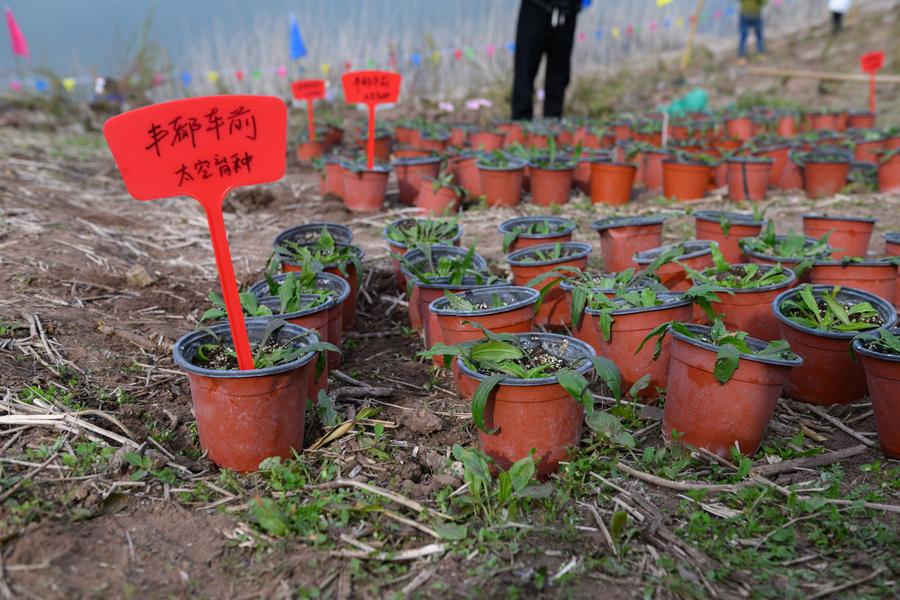
The technology has also opened new opportunities for rural economic development in China. One success story comes from Taibai County in Shaanxi Province, where a raspberry project has been flourishing. By using space breeding techniques, local raspberry production has increased in both quantity and quality, which in turn has led to the creation of more than 3,000 jobs, boosting local employment and incomes.
In 2023, the Ma’ershan Space Raspberry Park in Taibai generated an annual output value of over 3 million yuan ($423,700). With growing incomes, the lives of local farmers have improved markedly.
Qianziyuan Agricultural Science and Technology Expo Park in Xining, Qinghai Province, has also become a benchmark in the field of space-based agricultural innovation, particularly in the cultivation of vegetables. The park now boasts sightseeing zones, demonstration fields, science education centers and Qinghai’s first space-bred crop exhibition garden. It combines several features: showcasing space-grown plants, growing unique crops, promoting advanced farming techniques and serving as a sightseeing destination.
China is achieving groundbreaking results in agricultural genetic research through aerospace technology. Space breeding is leading the charge in transforming traditional agriculture and pushing the boundaries of innovation and modernization.
Xiao Junyong is executive director of the Center for Science, Technology and Human Rights at the Beijing Institute of Technology; Fu Xing is a research assistant at the center.