How do Local Governments Fuel Private Sector Growth?
 Facebook
 Twitter
 Linkedin
 Google +
Appropriate governmental actions—focused on promoting the market economy and providing proper incentives—are key to stimulating a city’s growth.
From globally popular video game Black Myth: Wukong, which has garnered a dedicated player base around the world, to DeepSeek, an artificial intelligence (AI) model developed at an impressively low cost that rivals U.S. company OpenAI’s ChatGPT, and the perfectly synchronized robotic ensemble performing with precision at this year’s China Central Television Spring Festival Gala, a Chinese New Year’s Eve extravaganza that aired on January 28—these big tech breakthroughs have risen to prominence one after another, generating massive buzz.
While seemingly unrelated, they do have one thing in common: They are all the creations of private startups based in Hangzhou, Zhejiang Province in east China. The three groundbreaking innovations emerged from Game Science, DeepSeek and UniTree Robotics, respectively.
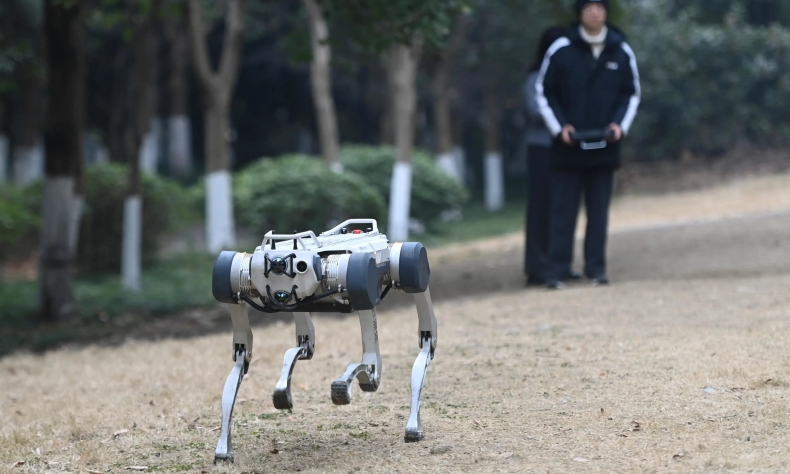
Recently, they have come to be known by a shared name—”Six Tigers of Hangzhou.” The other three members include ManyCore, a spatial intelligence company with over 320 million three dimensional models; BrainCo, whose bionic prosthetic hand ignited the torch at Asian Para Games Hangzhou in 2023; and DEEP Robotics, whose intelligent quadruped robots have been used for inspecting Singapore’s power tunnels.
The term “Six Tigers” naturally brings to mind the “Four Asian Tigers”—the Republic of Korea, Singapore, and China’s Taiwan and Hong Kong—four economies that experienced rapid growth from the 1960s to the 1990s. The fact that these companies have earned a similar title speaks volumes about their momentum and expansion.
As people applaud the achievements of the Six Tigers, their focus has also shifted to Hangzhou, previously most known as home to e-commerce giant Alibaba. How did this famous “e-commerce capital” evolve into China’s thriving hub for hard tech?
Business-friendly governance
In 2018, a recruitment delegation from the Hangzhou Future Sci-Tech City, a government-funded innovation incubator, discovered the startup team behind BrainCo in a basement in Boston, the U.S.
“We explained our brain-machine interface technology to the delegation and showed them some of the rough prototypes we had at the time, which they recognized and appreciated,” He Xiyujin, a partner at BrainCo, told Chinese newspaper Securities Times. “We were thrilled. It felt like a talented horse had finally found its jockey.”
Although brain-machine interfaces were still a concept found only in science fiction, the delegation immediately realized the potential for future industry growth. They wasted no time in offering an invitation for BrainCo to move to Hangzhou, providing incentives like rent reductions and comprehensive “on-demand” services.
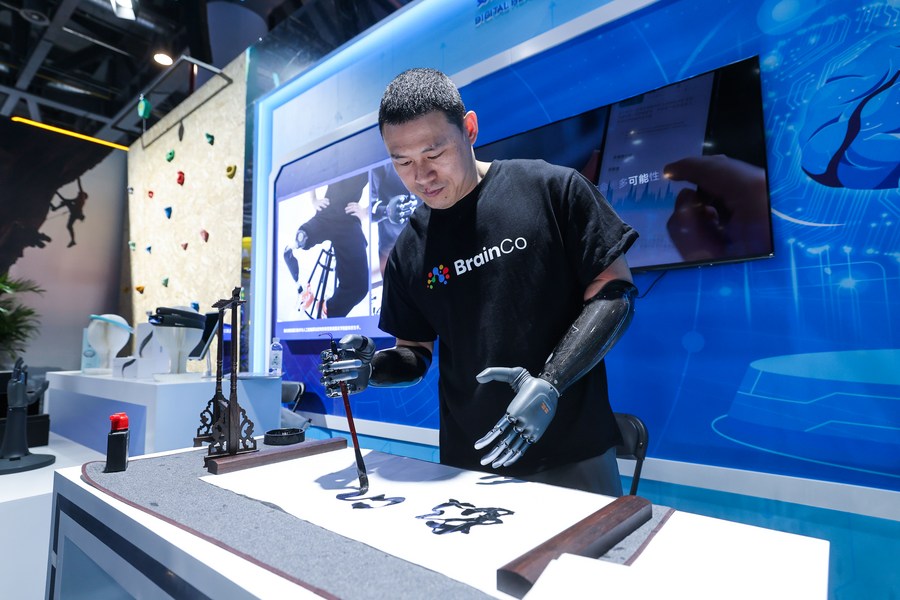
This is why BrainCo, founded in the U.S. in 2015, relocated to Hangzhou in 2018 and established its headquarters there. Over the past decade, BrainCo has evolved into one of the two largest companies in the world in terms of both fund raised and research and development investment in the field of brain-machine interfaces, alongside Elon Musk’s Neuralink.
Li Daokui, Director of the Academic Center for Chinese Economic Practice and Thinking at Tsinghua University in Beijing, pointed out on his personal social media that Hangzhou’s success can be attributed to its policies in talent acquisition and investment attraction, as well as its thoughtful government services.
Since 2016, Hangzhou has topped the ranking of cities in terms of net talent influx in the country. In 2017, it became the first city to offer subsistence subsidies to college graduates. By 2019, these one-time subsidies had grown, with undergraduates receiving 10,000 yuan ($1,373), master’s graduates 30,000 yuan ($4,120), and Ph.D. graduates 100,000 yuan ($13,734).
For entrepreneurial businesses, substantial tax incentives and office rent subsidies are available. Hangzhou once provided up to 100-percent rent subsidies for Game Science over a span of three years. In 2023, it also offered the company tax reductions totaling over 28 million yuan ($4 million).
As for humanoid robot firm UniTree Robotics, in 2017, after exhausting its funding with no products to show for it, a necessary injection of several hundreds of thousands of U.S. dollars from a state-owned platform in Hangzhou helped revive the company, pulling it back from the brink of failure.
In terms of government services, the principle of “no request, no interference” is strictly followed.
While these policies and services are also in place in other cities, what makes Hangzhou stand out? Li mentioned the role of Alibaba, which has infused the city with a strong online industry ecosystem.
As of 2024, the private sector accounted for 28.8 percent of Hangzhou’s GDP. This robust foundation provides ample nourishment for startup companies, offering them the resources and support they need to flourish.
Effective models
The “Hefei model” is another example of how local governments empower private enterprises. In 2008, Hefei, capital of Anhui Province in east China, allocated one third of its annual fiscal revenue to attract leading domestic display maker BOE Technology, which was facing losses exceeding 1 billion yuan ($137 million) at the time. This investment led to the establishment of China’s first sixth-generation LCD panel production line. Soon after, supporting companies in areas such as glass substrates, polarizers and module manufacturing followed suit. Over time, Hefei gradually built a new, trillion-yuan (over 100-billion-U.S. dollar) display industry chain.
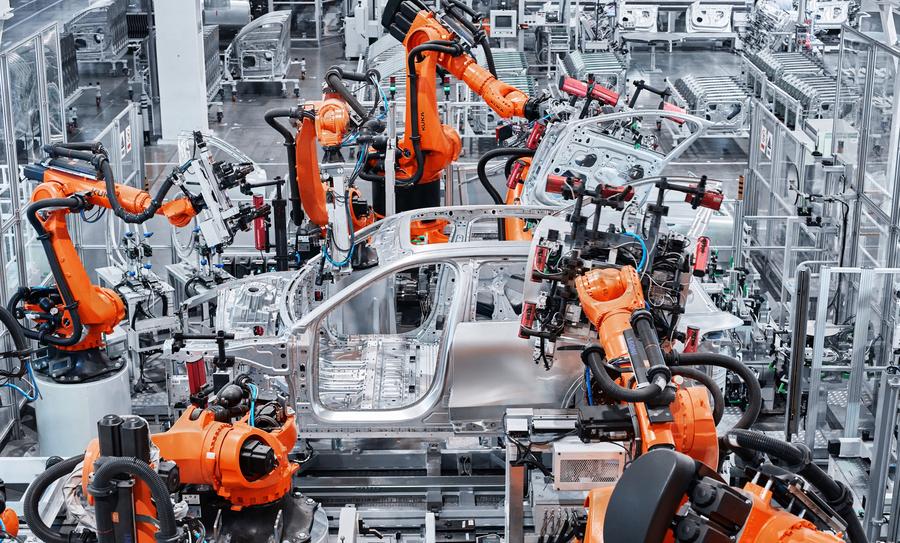
In 2020, Hefei invested 10 billion yuan ($1.4 billion) to support struggling electric vehicle company NIO, helping it overcome financial difficulties and positioning itself at the forefront of the new-energy vehicle industry. In China, new-energy vehicles refer to vehicles completely or mainly driven by new energy sources, including battery electric vehicles, plug-in hybrid vehicles and fuel-cell?vehicles.
Compared to the traditional approach where governments attract businesses through a favorable business environment and preferential policies, the Hefei model refers to the government using state-owned investment platforms to fund high-quality projects, helping them establish a foothold in the city. Once these projects grow and thrive, the government exits its investments through means such as public stock listings or equity transfers, realizing returns on its investments.
Another defining characteristic of Hefei’s investment attraction strategy is to make full use of flagship enterprises’ role in forming a localized industrial chain. Last year, Fuyao Glass, the world’s largest automotive glass maker based in southeast China’s Fujian Province, announced an investment of 5.75 billion yuan ($793 million) to establish three wholly-owned subsidiaries in Hefei. The company highlighted that Anhui is home to numerous automobile manufacturers like NIO, and this collaboration will help Fuyao Glass leverage the “pull effect” of leading industry players, attracting more up and downstream enterprises.
Drawing inspiration from the successful experiences of Hangzhou and Hefei, other regions are beginning to explore models tailored to their own strengths.
At a meeting on boosting Guangdong Province’s high-quality development on February 5, Huang Kunming, Secretary of the Communist Party of China (CPC) Guangdong Provincial Committee, said leading Chinese digital tech company Huawei, which is headquartered in the province’s Shenzhen City, is empowering a wide range of industries. He also praised DeepSeek and UniTree Robotics, emphasizing that China is demonstrating “a new momentum of leading the tides of the era,” and Guangdong should strive to take the lead in this competitive race.
On February 6, at Guangxi Zhuang Autonomous Region’s meeting themed on empowering a high-quality economy and fostering new growth drivers, Chen Gang, Secretary of the CPC Guangxi Zhuang Regional Committee, stressed that the AI model developed by DeepSeek has become a global sensation. This, he said, is a testament to the limitless potential of the AI era. He called on Guangxi to “avoid self-deprecation and sluggishness, but instead to position itself at the forefront of this technological wave.”
Li said the Hangzhou model is not one that can be easily replicated. However, other cities can leverage their individual strengths—whether in natural resources or manufacturing industries.
“All cities can learn from the Hangzhou authorities’ approach to the economy,” Li added. He highlighted that the appropriate governmental actions—focused on promoting the market economy and providing proper incentives—are key to stimulating a city’s growth.