From Serfdom to Freedom
 Facebook
 Twitter
 Linkedin
 Google +
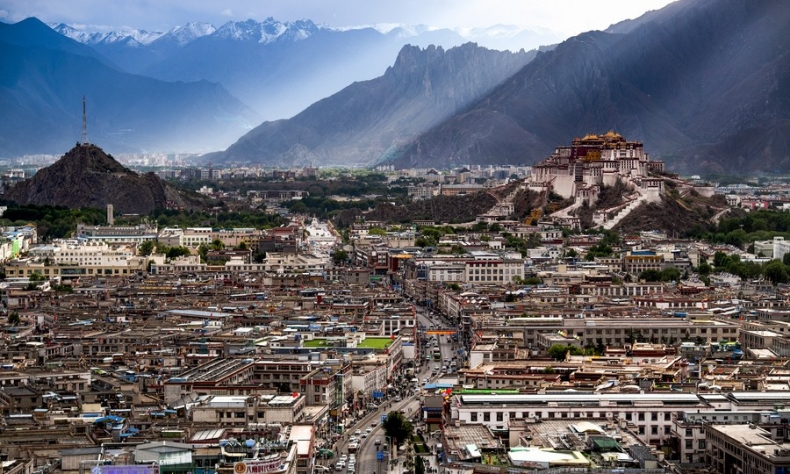
‘Before the democratic reform, the wealthy had supreme power whereas the poor people had no political rights. It’s the reform that granted us political rights and we are now free to speak our minds without fearing the wealthy.’
Padma was 17 when the democratic reform was introduced in Xizang in 1959. Before the reform, the region had been ruled by feudal serfdom under a theocracy for centuries. Nearly 1 million serfs were subjected to estate-holders’ cruel exploitation and oppression. Padma was one of them.
Born into a serf family in Xainza County, Nagqu, in north Xizang, Padma spent his adolescent years working as a houseboy for “Masters” in a local noble family. “I rarely got enough food to eat,” Padma told Beijing Review. In winter, he was not given warm shoes and the only way to keep his feet warm was to wrap them up in rags. He thought at the time he would serve the noble family for his whole life.
A turning point
The turning point came in 1959 when feudal serfdom was abolished as part of the democratic reform and approximately 1 million serfs were emancipated. The reform abolished the feudal bondage of individual serfs to serf owners, not only granting serfs personal freedom and equal rights, but also providing them land, livestock and other means of production to improve their socioeconomic status.
“Everything changed. We are no longer slaves for masters. Instead, we’ve become masters of our own lives,” Padma told Beijing Review. After the reform, he received professional training and became a village veterinarian in 1963. “We work for ourselves and get paid. The more we work, the more we gain,” he added.
The reform also enabled former serfs to have a say in public affairs. In 1970, Xainza County established a democratic reform committee and Padma was elected deputy director. “Before the democratic reform, the wealthy had supreme power whereas the poor people had no political rights. It’s the reform that granted us political rights and we are now free to speak our minds without fearing the wealthy,” Padma said.
In 1973, Padma became a member of the Communist Party of China (CPC). “I joined the Party to serve the people. And I did everything I could for the people,” Padma said. Thanks to his outstanding performance, he was appointed as the Secretary of the CPC Gaitso Township Committee one year later.
After he took the position, he faced a challenge: There were not enough pastures for the increasing number of livestock in their county and herders sometimes fought over access to grasslands. In pursuit of new grazing lands, Padma in 1976 led 60 households to relocate further north to the uninhabited grasslands in Changtang, which is now Gaitso Township in Shuanghu County. The new town has an altitude of 4,900 meters and is 718 km away from Lhasa, capital city of Xizang.
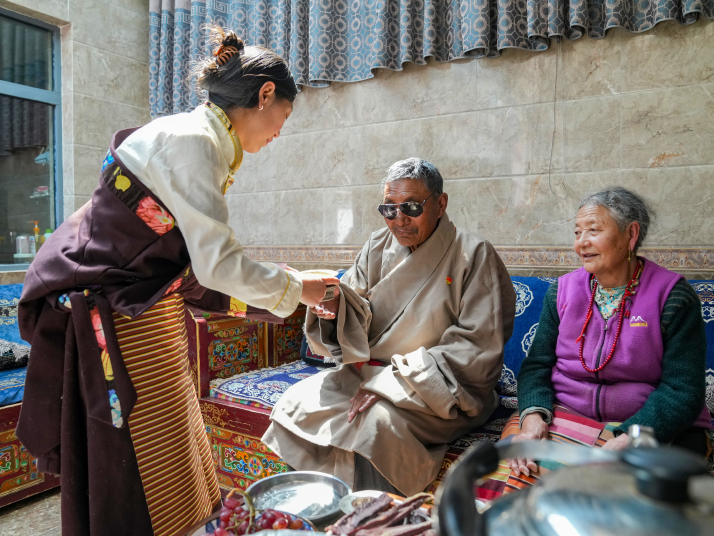
The Shuanghu Office, an administrative organization, and the Gaitso People’s Commune were established in the same year. A distribution system was set up in the commune, under which individual income was allocated based on each person’s contribution, measured in work points. With Padma as the leader, residents started from scratch, and eked out a living on the once-uninhabitable land.
In 1982, after the launch of reform and opening up in China, people’s communes across Xizang were dissolved and the household contract responsibility system, under which the farmland owned by the village collectives was contracted out to individual households, was implemented. In the next year, residents of Gaitso People’s Commune held meetings to discuss their future direction. Some 70 percent of the residents voted to keep the people’s commune as they believed that collective operations are more effective and efficient in the vast grassland.
Over the following decades, the commune’s villagers have continually optimized the distribution system based on the principle of “more pay for more work.” As a result, the commune has worked well and continues to operate to this day. Thanks to their collective efforts, the commune’s per-capita disposable income has been higher than the average of the whole region for decades. In 1989, Padma was awarded the title of National Model Worker for his outstanding performance.
In the following years, more and more herders moved onto the Changtang grassland. And in 2012, a decade after Padma had retired, the Shuanghu Office was updated into a county-level government to better serve those living in Changtang. Shuanghu is now the youngest and highest county in China.
To this day, Gaitso remains the only people’s commune in Xizang. In 2024, the per-capita disposable income of the commune was 28,500 yuan ($3,939), 23 percent higher than the national average for rural residents.
A difficult decision
Nevertheless, life is not a fairytale and new challenges arise in Shuanghu residents’ lives.
Shuanghu County sits at an average altitude of over 5,000 meters, with oxygen levels only 40 percent of those at sea level. Due to its remote location and harsh environment, Shuanghu residents constantly faced challenges such as difficulty accessing clean drinking water, medical care and transportation. In many remote villages, people had to rely on melting ice for daily water needs.
The county experiences a high incidence of plateau-related diseases such as rheumatism and heart disease, with an average life expectancy of just 58 years—about 14.5 years lower than the average in Xizang. In 2024, Xizang’s average life expectancy increased from 35.5 years prior to 1959 to 72.5 years, more than doubling.
What’s more, Changtang is home to nearly 500 species of plants, as well as endangered wild animals unique to the Qinghai-Xizang Plateau. These include the Tibetan wild ass, wild yak, Tibetan gazelle, Tibetan brown bear, black-necked crane, snow leopard and Tibetan antelope.
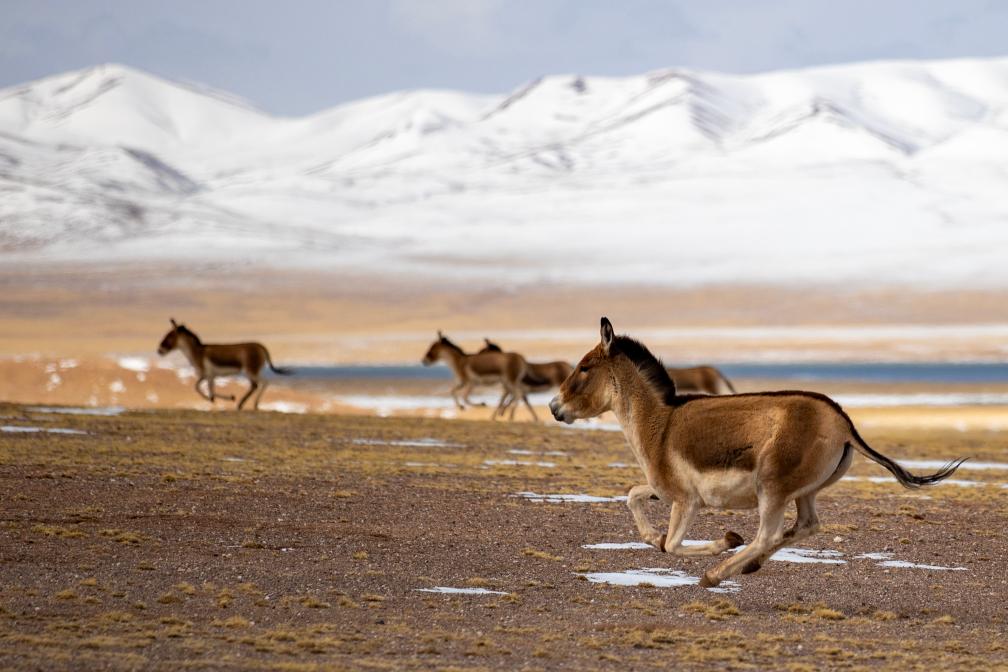
In 1993, the Changtang Nature Reserve was established and was upgraded into a regional-level reserve by the Xizang Autonomous Regional Government. Seven years later, on April 4, 2000, it was upgraded to a national nature reserve. Covering a total area of 29.8 million hectares in Xizang and Qinghai Province, it is the largest nature reserve in China and the second-largest terrestrial nature reserve in the world, second only to the Northeast Greenland National Park in Greenland.
As the population grew in Changtang, competition for space between humans, livestock and wildlife became increasingly prominent. At the end of 2019, in an effort to resolve the challenge of human-nature coexistence and provide more space for wildlife, and ensure a better life for residents, the local government persuaded Shuanghu residents to relocate south to Singpori Village in Gonggar County, Shannan City, on the north bank of the Yarlung Tsangpo River.
“Life in Shuanghu was tough, but after working hard to build our home for over 40 years, it was hard to leave. At first, I didn’t want to move,” said Padma. However, realizing that the relocation was for the greater good, Padma and 2,900 other villagers agreed to migrate to Singpori, marking their second major relocation in life.
The new settlement, located just over 10 km from Lhasa Gonggar International Airport and about 60 km from Lhasa City, was equipped with rows of newly built Tibetan-style houses funded by the government. The site also featured a well-equipped hospital, school, market and convenient transportation.
Singpori sits at a much lower altitude—over 1,400 meters lower than Shuanghu. After moving, many villagers noticed that winter in Singpori felt like summer in Shuanghu. The warmer weather made breathing easier, sleep more sound and daily life more convenient.
Some younger people have found jobs or started up small businesses in nearby industrial parks while others remain in the old settlement in Shuanghu, taking care of their livestock. Herding will be phased out of the Changtang National Nature Reserve gradually in upcoming years.
Better medical care
For Padma, now 83 years old and with limited mobility, Singpori is a much better place to enjoy retirement. With running water available and a clean toilet inside the house, everyday life became significantly easier.
And what’s more important for him is that he now has easier access to medical care in the new settlement. When he lived in Shuanghu, the nearest county-level hospital was 70 km away from his village. Now, a new hospital is within walking distance.
Many people, like Padma, have benefited from the development of Xizang’s healthcare system. Across the region, there are now 1,821 medical and health institutions with a total of 22,000 hospital beds.
The immunization coverage rate in Xizang has remained above 90 percent for many years, and eligible women can receive free HPV vaccinations. The implementation of child nutrition programs has significantly enhanced the health conditions of children in the region.
Many common plateau diseases have been brought under control—iodine deficiency disorders have been nearly eliminated, and there have been no new cases of Kashin-Beck disease since 2018. The prevalence of echinococcosis has also significantly declined.
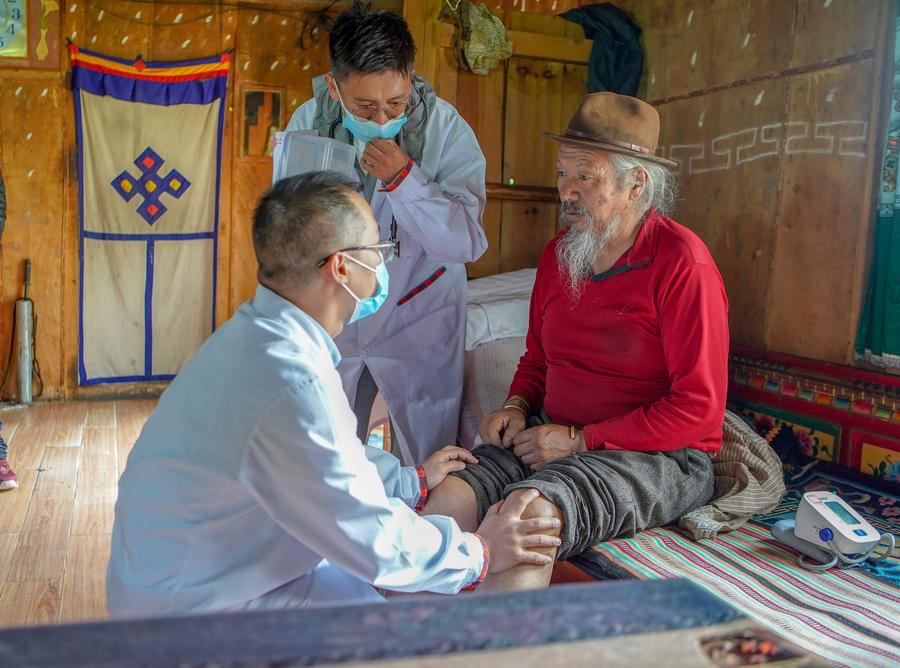
This progress in healthcare would have been impossible without the support of the medical aid program for Xizang. Since the 1990s, medical workers from renowned hospitals across the nation have signed up to work in Xizang to accelerate the development of medical and health services in the region.
Since 2015, medical assistance to Xizang has been intensified with medical teams from top hospitals in the most economically advanced cities like Beijing, Shanghai and Guangzhou in Guangdong Province arriving in the region. The eight biggest hospitals in Xizang had all of their departments team up with corresponding departments in top-notch hospitals in other parts of China. The arrangement aims to develop the expertise of Xizang’s hospitals so that they can also qualify as top-notch hospitals. It also means patients don’t have to look for treatment outside the region, saving them money as well as time.
“This kind of medical aid for Xizang has enhanced both life quality and sense of happiness in the region,” Nyima, Vice President of Lhasa People’s Hospital and a deputy to the 14th National People’s Congress, told Beijing Review. “Every (visiting) team is comprised of doctors from different departments. They don’t come just to perform surgeries or treat patients. Through mentorship programs, they have also trained many local doctors, leaving behind a skilled team that will never leave,” she added.
By the end of 2024, 184 hospitals from other provinces and municipalities had sent nearly 2,000 experts to assist Xizang’s healthcare sector. They introduced more than 4,400 new medical projects and technologies, filling over 2,500 gaps in the region’s medical expertise.
At the same time, Tibetan traditional medicine has also seen remarkable growth in recent years. Currently, Xizang has over 5,200 specialized Tibetan medicine professionals, 51 Tibetan medicine institutions, full coverage of Tibetan medicine services at the community level, and a service coverage rate exceeding 94 percent in townships. The Tibetan Hospital of Xizang Autonomous Region, founded in 1916, has developed into the country’s largest Tibetan medicine hospital integrating medical treatment, teaching, scientific research, prevention, health care and Tibetan medicine preparation.
On December 19, 2024, the inauguration ceremony for the National Traditional Medicine Center (Tibetan Medicine) was held in Lhasa. This is the first national-level ethnic medicine center officially in China.
The center will focus on common critical illnesses in high altitude regions, integrating medical care, education, research and industrial development. It aims to establish a high-quality medical center specializing in stroke treatment and Tibetan medicinal bathing therapy while promoting the development of other medical disciplines.
“In my 31 years as a doctor, I have witnessed the transformation of Xizang’s healthcare system—from having few medical institutions to many, from a small medical workforce to a large one, and from weak medical capabilities to strong ones,” Nyima said.
Access to healthcare is an essential foundation for people’s pursuit of a better life, Tashi Dondrop, President of the Ali Prefecture Tibetan Hospital said.