Cultural and Historical Origins of the Central Axis of Beijing
 Facebook
 Twitter
 Linkedin
 Google +
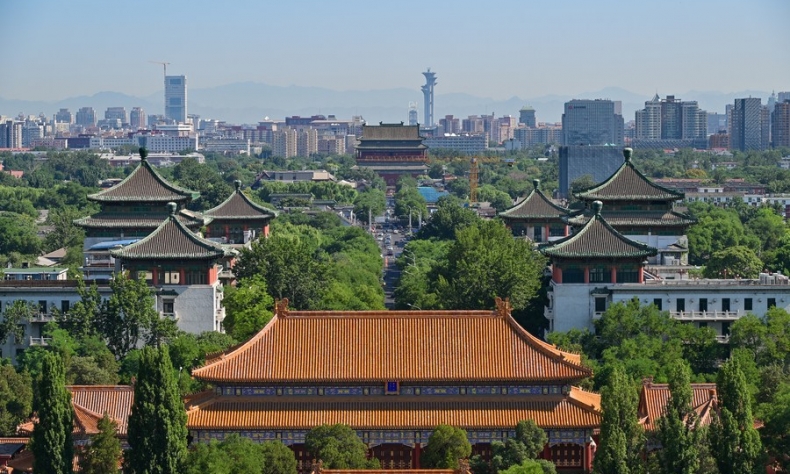
The Central Axis of Beijing embodies the cultural spirit and urban planning ingenuity of an ancient nation.
President Xi Jinping has said that cultural relics and heritages are the carriers of the Chinese nation’s genes, and are nonrenewable and irreplaceable sources of Chinese civilisation. Highlighting the role of history and culture as the soul of a city, Xi has laid great importance on the application of the Beijing Central Axis for a World Heritage Site. This application should be taken as an opportunity to ramp up the city’s efforts to protect cultural relics and improve their surroundings, Xi stressed.
Order and grandeur
Stretching 7.8 kilometres, the Beijing Central Axis begins at the Drum Tower and Bell Tower in the north, running across Wanning Bridge, Jingshan Hill, the Forbidden City, Duanmen Gate, Tian’anmen Gate, the Outer Jinshui Bridge, Tian’anmen Square and its complex, the Zhengyang Gate, and ruins of roads on the south section of the Central Axis, ending at Yongding Gate in the south. The Imperial Ancestral Temple, Altar of the Land and Grain, Temple of Heaven, and Altar of the God of Agriculture sit symmetrically in the west and east wings of the Central Axis. The 15 cultural and historical sites are the constituents of the Beijing Central Axis. The axis connects the most important national memorial erections, and ritual and landmark buildings in Chinese history since the 13th century, as the representative embodiment of Chinese civilisation.
Grand and magnificent, the Central Axis of Beijing also displays comparison and variation in its orderly and harmonious layout. Symmetrically distributed, its panoramic view exhibits changes in the well-proportioned and well-spaced buildings, which were constructed based on hierarchical requirements. Thus, cadence is created, with proprieties and ritual traditions embodied in the grand spatial pattern, displaying the unique aesthetics and connotations of Chinese culture. The Central Axis expresses rites and order through traditional Chinese urban planning.
Incarnation of Chinese civilisation
The formation and development of the central axis pattern in ancient Chinese capital cities extends over a long period of history. Though China’s first unified dynasty, Qin, came into being in 221 B.C., it was not until the Wei and Jin dynasties (220-420) that the three-tier capital city layout composed of the palace city, the royal city, and the outer city took shape. Also during this period, the central axis pattern emerged in capital cities.
As a quintessential example of the central axis pattern in traditional Chinese capital cities, the Beijing Central Axis embodies the architectural styles of the Yuan, Ming, and Qing dynasties, and also presents a new look of the city’s development in contemporary times as the core area of the city.
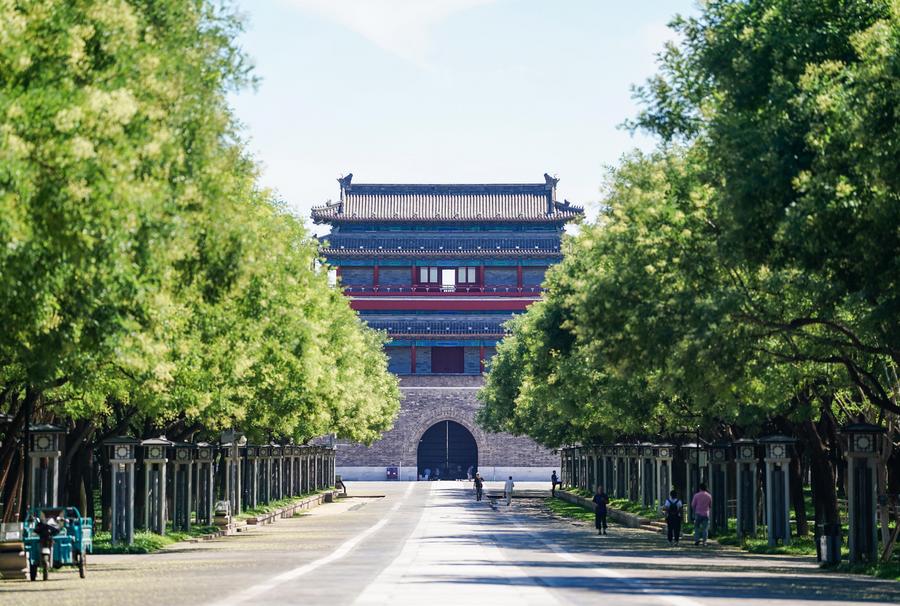
Combining multiple functions, the Central Axis links royal palaces, gardens, ritual and celebration locations, as well as urban management facilities like city gates, the Drum Tower and Bell Tower, and commercial streets and markets related to people’s daily lives. As the sole axis in existence in the form of buildings which have been well preserved, the Beijing Central Axis shows the unique aesthetic value of the ancient Chinese capital city layout, with its orderly spatial pattern and grand scale, and continues exerting important influence on contemporary urban development, demonstrating the lasting vitality of traditional Chinese urban planning.
Embodying the essential cultural value and pursuit of the Chinese civilisation, the Beijing Central Axis is a unique contribution of the Chinese nation to human civilisation. These ancient Chinese philosophical concepts and value orientation can all find their expression in the Central Axis, like harmony between humans and nature, and valuing order.
Of note is the importance attached to sacrificial rites by the Central Axis, as its constituents the Imperial Ancestral Temple, Altar of the Land and Grain, Temple of Heaven, and Altar of the God of Agriculture were all foremost national venues for sacrificial and ritual activities in old times, once regarded as very important national events. These altars and temples together with other buildings along the Central Axis have become the embodiment of the inclusive and diversified traditional belief system of the Chinese nation.
Running through multiple urban zones of different functions from north to south, the Central Axis in the old city of Beijing has witnessed regal court life, the life of aristocrats and officialdom in the inner city, and the ordinary folk life in the outer city. It therefore becomes a comprehensive tangible carrier of traditional Chinese social life. In addition, an abundance of intangible cultural heritages associated with the ancient buildings along the Central Axis also reflect the traditional life of people there.
Historical evolvement
The Beijing Central Axis has evolved in tandem with the urban development of Beijing since its founding in the Yuan Dynasty (1267-1368). It was first built in 1267, took shape in the Ming Dynasty (1368-1644), and was then further expanded and improved in the Qing Dynasty (1644-1911) and then later, the modern era. The majestic and orderly historical building cluster constitutes a quintessential part of the ancient capital city of Beijing’s unique urban landscape.
The axis began with the construction of Dadu (now Beijing), the capital city of the Yuan Dynasty. The capital’s construction was based on the water system of Shichahai, with the central platform, also the datum point of the city’s construction, set at the east bank of the river system. The central axis for the layout of the whole city was then planned by extending the central datum point southward. Urban construction began with the palace city, after which boundary lines of the big city were demarcated in light of the central point, with city walls erected. After that, the locations of altars, temples, and government offices were identified. The Imperial Ancestral Temple and Altar of the Land and Grain were built respectively in the east and west wings of the Central Axis, symmetrically located. With residential areas defined, the orderly checkerboard-like layout of the whole city came into being. The pioneering practice of Dadu in planning the urban layout by first identifying the central point and then determining the locations of palaces, city walls, streets and residential blocks broke new ground in capital city construction in Chinese history.
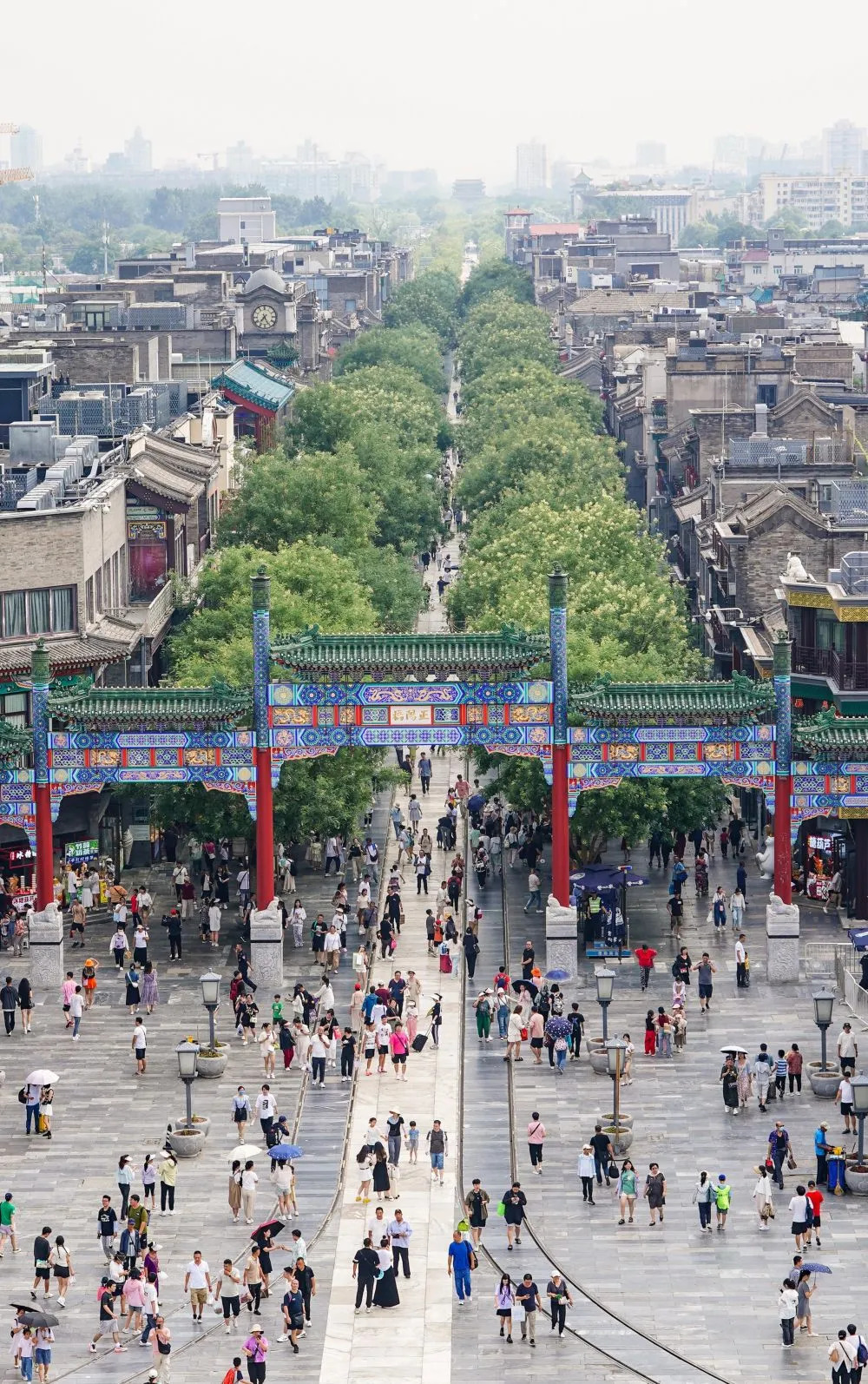
In the initial stage, the Central Axis ran 3.75 kilometres, starting from the central platform in the north, then extending southward across the Wanning Bridge, the royal garden, the palace city, and the royal complex to the Lizheng Gate (now Zhengyang Gate). This preliminary pattern laid the foundation for the later development of the Central Axis.
During the reign of Emperor Yongle (1403-1424) of the Ming Dynasty, the inner city was built on the basis of the Central Axis with the east and west city walls of the previous Yuan Dynasty retained, but the south wall was relocated farther south, with the city gate still symmetrically placed along the Central Axis. Almost all major heritage constituents of the axis took shape during this period; the axis was also extended by around one kilometre with its northernmost point being the Bell Tower, which was built during the Yongle reign, and ended at the central south gate of the inner city, Lizheng Gate (now Zhengyang Gate).
During the reign of the Ming Emperor Jiajing (1553-1564), to fortify the military defense, the capital city built its outer city to the south of its inner city. The streets and residential blocks in the north of the inner city retained the original Yuan Dynasty orderly layout. The blocks along the straight and broad central road on the axis in the south mostly featured zigzagging and narrow lanes following the natural geographical conditions. Also during this period, the south end of the Central Axis was extended to the Yongding Gate, with its total length reaching 7.8 kilometres. The overall spatial layout of the original axis was kept during the Qing Dynasty. When it came to the reign of Emperor Qianlong (1735-1796), the Shouhuang Palace complex was relocated to the Central Axis from the northeast corner of the Jingshan Hill, and five pavilions were built on the hill, further accentuating the symmetrical layout of the Central Axis.
In 1914, the Altar of the Land and Grain was open to the public as a central park, ushering in the popularization of the Central Axis. Accordingly, a range of alterations were made on the functions and layout of the royal buildings along the axis as the ritual space, which once served the royal authorities, has become the open space serving the public. Owing to a series of plans for overall urban development, the core area preservation, and heritage protection, the overall layout of the Central Axis has been preserved and protected.
As the core area of an ancient capital, the Central Axis of Beijing, together with the surrounding mountains of the city in the west and north, as well as the river system running from the west to the east of the city, which once decided its location and construction, jointly form a harmonious existence between culture and nature, tangible and intangible cultural heritage, as well as cultural relics and modern life. Whether being a unique carrier of Chinese civilisation, or an excellent urban planning example of the core area of a capital city, the Central Axis of Beijing has maintained its outstanding cosmopolitan value.