Confucius and American Democracy
 Facebook
 Twitter
 Linkedin
 Google +

The rapturous reception of Confucius’ works and historical examples of a productive exchange between China and the West may serve as a model for contemporary relations of China and the U.S. in the 21st century.
Upon?the establishment of European universities in the Middle Ages, the educational system in Western countries became characterized by an essentially Eurocentric worldview. This was reflected in the study of Latin and Greek in high school, and in basing public life and political systems on philosophies of classical antiquity. The work of the influential Chinese philosopher Confucius (551-479 B.C.), a near-contemporary of the major Greek philosophers Socrates (469-399 B.C.), Plato (428-348 B.C.) and Aristotle (384-322 B.C.), whose ethical and political ideas entered into the constitutions of European states, remained unknown.
It was by virtue of the adventurous and inquisitive spirit of Marco Polo, who in his youth traveled to China with his father and uncle, and spent 24 years (1271-1295) there, that the Eurocentric tradition began to change. The three journeyed along land and sea routes established in the Han Dynasty (206 BC-220 A.D.) and fully developed in the Tang Dynasty (618-907). It was in 1877 that German geographer Ferdinand von Richthofen became the first to define this well-traveled pathway between Europe and East Asia as the Silk Road. Marco Polo’s summation of his impressions of China in his?Book of the Marvels of the World?(also known as?The Travels of Marco Polo) in 1300 created an Eastern perspective for European scholars. His writings undoubtedly motivated the Pope’s dispatch of Jesuit missionaries to China in the 16th and 17th centuries to introduce Christianity to the Chinese people. Fortunately, however, the originally intended one-way transfer of European beliefs to China transmuted into a fruitful exchange of ideas.
It was the Latin translation of Confucius’ works, namely:?Confucius Sinarum Philosophus?(Confucius, the Philosopher of China: The Chinese Learning Presented in Latin), by four Jesuits, published in Paris in 1687 and dedicated to the French King Louis XIV, that sparked the influence of Confucius’ ideas on Europe, ultimately rendering him “patron saint of the 18th-century Enlightenment,” according to economist and educator Adolf Reichwein’s treatise of 1925. German philosopher, mathematician, and diplomat Gottfried Wilhelm Leibniz’s response to this landmark publication, expressed in?Novissima Sinica?(The Newest from China) in 1697 was to herald Confucian ideas as the beginning of a mutual exchange, whereby Europeans may learn from the Chinese an “application of a practical philosophy and a form of life based on reason.”
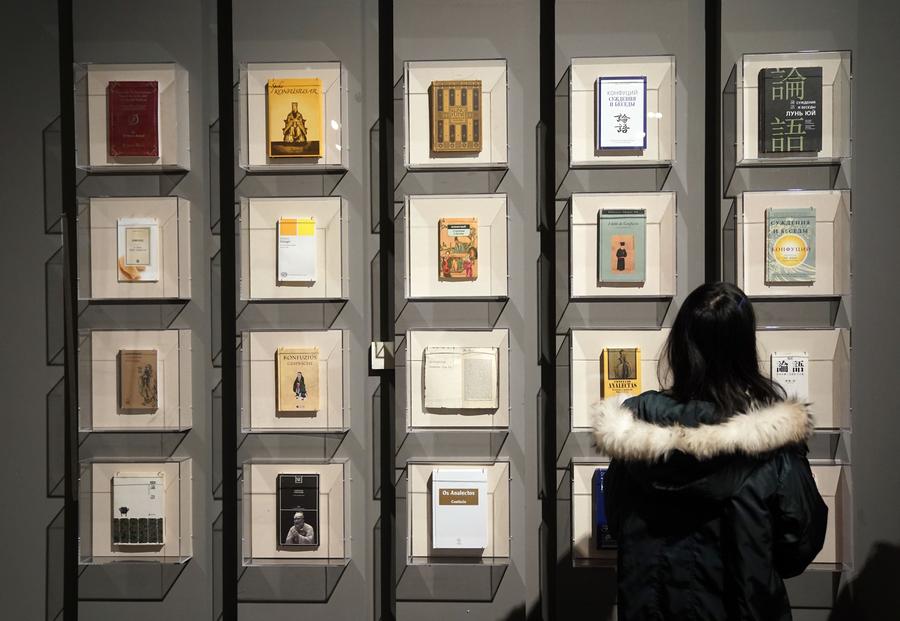
During his first trip to England (1724-26) as an 18-year old, American founding father Benjamin Franklin undoubtedly read the English translation, published in London in 1691, of the original Latin works of Confucius:?The Morals of Confucius, a Chinese Philosopher Who Flourished above Five Hundred Years before the Coming of Our Lord and Savior Jesus Christ, being one of the most choicest pieces of learning remaining of that nation, a title that relates the sage’s morals to those of Christianity. Upon his return to Philadelphia, Franklin wrote a summary of the Chinese philosopher’s ideas titled, “From the Morals of Confucius,” which was published in two issues of his journal?The Pennsylvania Gazette?(1737). For him, Confucius’ book was “the gate through which it is necessary to pass to arrive at the sublimest wisdom and most perfect.”
Achievement of this goal of virtuous perfection, Franklin tells his fellow Americans, requires obeyance of Confucius’ instructions “to cultivate our minds and regulate our manners,” “to instruct and guide others,” and “to tend to the Sovereign Good.” A comparison of Franklin’s writings with The Analects reveals a similar expression of ideas, the former of which became part of the public discourse among American intellectuals and politicians on the pathway to a new political formation which would be independent of the morally corrupt monarchies in Europe of 1776.
Acknowledgement of the importance of individual education and a concern for that of others would qualify a leader on the basis of merit, rather than that of hereditary rights, by virtue of following the Confucian precept instead of bowing to European traditions. This focus on the power of the individual was part of the gradual transition from the religious origins of the English colonies to the political foundation of an independent American society. In the perception of European and American readers, Confucius’ ideas antedate and anticipate the beliefs of Christianity, in effect replacing them with an orientation toward the public life of a mundane state.
In the wake of Franklin’s publications, American intellectuals, writers, and politicians routinely referred to the importance of the Confucian concepts of benevolence and the happiness of the people that the Chinese philosopher had expressed 500 years before the coming of Jesus Christ. Next to “life” and “liberty,” “the pursuit of happiness” belongs to the unalienable rights, as formulated in the Preamble to the Declaration of Independence (1776).

In light of the similar phraseology of Confucius and Franklin’s works, contemporary American statesmen also frequently adopted Confucius’ ideas. Thus, in their correspondence, John Adams and Thomas Jefferson, the second and third presidents of the United States, discuss Confucian morality. Jefferson included in the?Thomas Jefferson’s Scrapbooks:?Poems of Nation, Family, & Romantic Love Collected by America’s Third President?a poem from the Great Learning, about the Chinese prince of Guey from the province of Honang whom he regards as a paradigmatically virtuous political leader that practices harmony and benevolence. James Madison, the fourth president and acclaimed Father of the Constitution of the United States, hung a portrait of Confucius in his Virginia home. The president of Yale University, Ezra Stiles, called Franklin “the American Confucius.” It is hence no exaggeration to claim that Confucian ideas influenced the American revolution and the foundation of the United States. As early as 1784,?The Empress of China?sailed from New York to China to open up trade, and brought back rice, Chinaware, herbs, and tea, so adding a commercial facet to the transatlantic relations.
Confucius’ rapturous reception continued into the 19th century through American literature and culture, and was in the 20th century prominently endorsed by the expatriate American writer and critic Ezra Pound. Pound translated Chinese poetry and Confucius’ works, so affirming the sage’s importance to Western culture, and deploring the neglect of Chinese traditions during the Republic of China (1911-1949). In a series of poems, among his “Cantos” of 1940, about Chinese civilization and the second American President John Adams, Pound compared China’s long history to the short American one. And in his article, “Immediate Need of Confucius” of 1937, Pound claimed that the Chinese philosopher was essential to the regeneration of Western political systems and cultures. A material expression of this belief lay in the construction in 1935 of the Supreme Court Building in Washington DC, whose eastern pediment features the three great lawgivers: Confucius, Moses, and Solon. Sculptor Herman A. MacNeil’s statues of the Chinese philosopher, the Biblical Jewish leader, and the Athenian statesman constitute his recognition of “law as an element of civilization” which is “inherited in this country from former civilizations” of the East. This would seem to conform with the statement by Honorary President of the China Confucius Foundation Gu Mu in 1989 that Confucius remains not only the Great Presence of China but China’s great gift to the world.
Through initiation in 2004 of Confucius Institutes around the world, China acknowledges the importance of the sage’s legacy to teaching the Chinese language and promoting the long history of Chinese civilization. For the American journalist Christopher Wren, “Confucianism, with its innate respect for authority … offers China an indigenous alternative to Western democratic pluralism….” He, moreover, regards Confucius as “an ancient Marx” (The New York Times, 1984). The rapturous reception of Confucius’ work and historical examples of a productive exchange between China and the West since the Enlightenment may serve as a model for contemporary relations of the two global players, China and the U.S., in the 21st century.
Alfred Hornung is research professor and director of the Obama Institute for Transnational American Studies, Johannes Gutenberg University, Mainz, Germany.