China’s Case for More Effective G20
 Facebook
 Twitter
 Linkedin
 Google +
Although tensions persist in several areas, China’s G20 message fits within a wider effort to reduce unpredictability in its external environment.
The Group of 20 has always been at its best when major powers put aside tactical disputes and focus on stabilizing the global economy. At a moment when recovery remains uneven and political frictions proliferate, China’s approach at the Johannesburg summit illustrates how a large economy can play a constructive role without adding to fragmentation that already burdens global affairs.
Chinese Premier Li Qiang’s speech?captured this tone. His message was neither triumphalist nor defensive. Instead, it reflected a sober view that the world’s economic institutions are under strain and that the G20 has a responsibility to prevent the fractures from widening. Li urged the members to “stay committed to solidarity” and to “firmly uphold free trade”, a reminder that even in a climate of distrust the world cannot afford to let economic interaction wither. His language was measured, yet it pointed to a clear concern that protectionist trends are gathering speed and that the resulting uncertainty could push the global economy into deeper distress.
This position reflects China’s assessment that unilateral restrictions, rival industrial policies and weaponized supply chains pose a long term threat not just to developing economies but to the advanced economies?as well.?Li drew attention to the fact that the current turbulence is not driven only by market cycles. It is the product of policy choices, especially those that treat interdependence as a vulnerability rather than an advantage. Against this backdrop, China has tried to frame the G20 as a venue where countries can “properly handle disputes and frictions through consultation on the basis of equality”. It is an appeal for process rather than power politics.
The global context for this message has grown sharper over the past year. Growth prospects for 2025 have been revised downward by several international institutions. Inflation remains stubborn in parts of the West, while the Middle East’s instability continues to send tremors through energy markets. Trade tensions between the United States and several Asian economies have increased, and new export controls have added layers of complexity to the technology supply chain. The result is an atmosphere of caution that discourages investment and limits the willingness of governments to commit to long term cooperation.
China’s argument, as articulated by Premier?Li, is that the G20 is a rare format where emerging and established economies can still find shared ground. He reminded members that solidarity has always been the forum’s driving force and that “division leads nowhere”, echoing?Chinese President?Xi Jinping’s earlier remarks. It was significant that Li did not dwell on geopolitical confrontation or seek to assign blame. He focused instead on the structural weaknesses that hinder global cooperation, including divergent interests and uneven institutional representation.
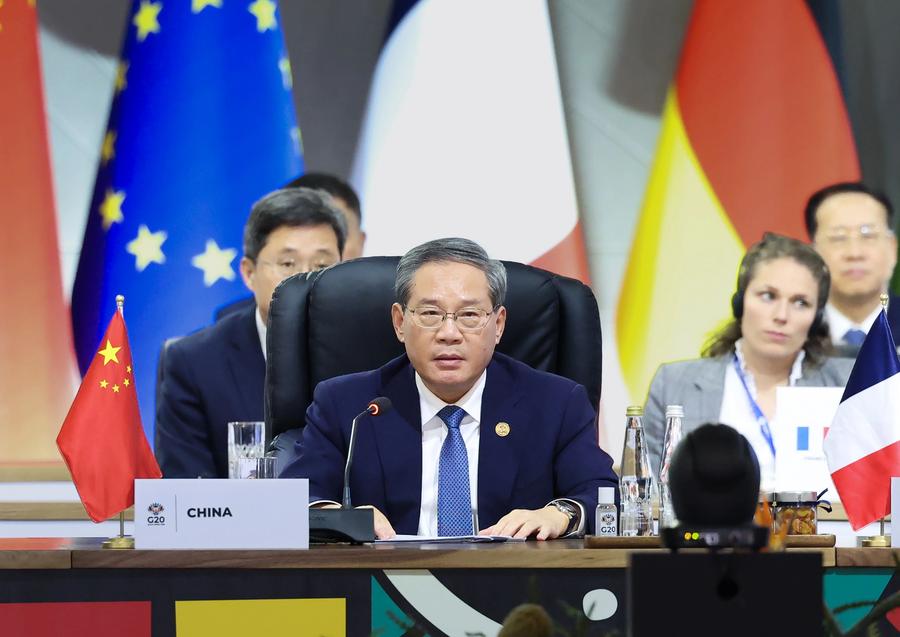
Here China has positioned itself as a supporter of institutional reform. Li called for a faster overhaul of the World Bank, the IMF and the WTO. This agenda is not new, but China’s insistence that it be accelerated reflects mounting impatience among developing nations who feel underrepresented in global decision making. At a time when the international financial system faces credibility challenges, updating quotas, lending tools and dispute mechanisms has become not only a matter of fairness but of functionality. By placing these reforms on the table, Beijing is signaling?that economic governance cannot keep relying on frameworks designed in a different era.
China’s emphasis on development remained central. Li highlighted the action plan for implementing the G20 Initiative on Supporting Industrialization in Africa and Least Developed Countries. At a moment when many large economies have turned inward, China’s attempt to sustain momentum in development cooperation sends an important message. Beijing’s backing for debt relief for vulnerable states and its joint initiative with South Africa to support Africa’s modernization point to an approach that seeks to combine multilateral coordination with bilateral mechanisms. The planned Institute of Global Development adds another layer to this effort.
This developmental focus is not just altruistic. China understands that global growth cannot be sustainable without addressing the needs of poorer economies, many of which are burdened by debt, volatility and limited investment flows. Several African states have warned that unless new financing arrangements emerge, they will face hard constraints on industrial expansion. By pushing for a fairer economic order and greater representation for developing countries, China is advancing positions that have broad resonance across the Global South.
Recent developments reinforce the relevance of this stance. Commodity export?dependent economies continue to face price swings that undermine fiscal planning. Climate related shocks have created new humanitarian emergencies. And as borrowing costs remain high, many states have had to scale back public projects that were meant to support long term growth. Within this difficult landscape, China’s message that the G20 must “seek common ground while reserving differences” speaks to the need for practical cooperation even when political disagreements persist.
China’s broader diplomatic strategy supports this posture. Beijing has been careful to portray itself as a stabilizing force rather than a challenger seeking to reshape international norms unilaterally. Its discussions with the European Union on trade imbalances, its recent outreach to ASEAN states and its efforts to maintain steady relations with major emerging economies all signal a preference for managing disputes rather than amplifying them. Although tensions persist in several areas, China’s G20 message fits within a wider effort to reduce unpredictability in its external environment.
Critics in some Western capitals argue that China’s appeals for open trade contrast with its own protective measures in sectors like data governance and technology. Yet this criticism overlooks the shared responsibility across large economies for the current climate of restrictions. Over the past three years the United States, the European Union and India have all expanded their lists of sensitive sectors and tightened screening rules for foreign investment?while China kept cutting the negative?list.?The global trend is toward greater state intervention, not just in China. In this sense, Li’s call to “advance with the times” while upholding multilateralism is directed as much at the West as at Beijing’s partners in the developing world.
The G20’s response to China’s message has been cautious but encouraging. Leaders at the summit affirmed that the forum remains an important platform for meeting shared challenges and safeguarding multilateralism. They stressed that reform of global governance structures is essential and that bridging the development gap must be at the centre of future cooperation. While these points do not translate into immediate policy change, they suggest that China’s emphasis on common interests rather than rivalry found a receptive audience.
The test will be whether the G20 can channel this language into concrete outcomes in the coming year. Institutional reform will require negotiation and compromise. Trade stability will depend on restraint from major powers. Development financing will need sustained commitment at a time when domestic pressures pull governments inward. But if the G20 is to remain relevant, it will need large members to act as responsible anchors rather than disruption engines.
In Johannesburg, China presented itself as such an anchor. In an era with rising mistrust, the insistence that solidarity still has value may sound modest. Yet it is exactly the kind of steady argument the G20 needs if it is to regain its capacity to guide the global economy through the uncertainty that lies ahead.
The article reflects the author’s opinions, and not necessarily the views of China Focus.