China Is Now a Global Innovation Powerhouse
 Facebook
 Twitter
 Linkedin
 Google +
In addition to pumping more money into science and technology development, China has been carrying out reforms to spark innovation.
China had long aspired to be an innovation powerhouse. Now, it is one. “In the past decade, China’s scientific and technological undertakings have undergone historic structural and overall changes. We have entered the ranks of countries of innovators,” Wang Zhigang, Minister of Science and Technology, said at a press conference on June 6.
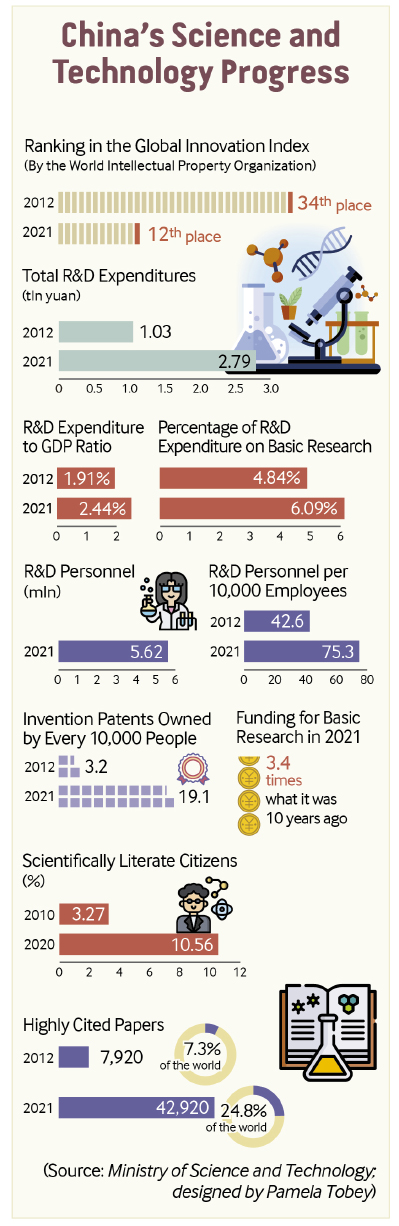
The country’s ranking in the Global Innovation Index, released by the World Intellectual Property Organization, rose from 34th place in 2012 to 12th place in 2021.
“China has significantly elevated its position and role in the global innovation landscape. We are not only an important participant in international frontier innovation, but also an important contributor to jointly solving global problems,” Wang said.
Unleashing creativity
Since the 18th National Congress of the Communist Party of China in 2012, China has put innovation at the center of national development. It has put forward the goal of building a country of innovators with strong science and technology, carried out an innovation-driven development strategy, followed a path of independent innovation with Chinese characteristics, and drawn blueprints for science and technology development, Wang said.
Science and technology output in China has been improving in both quantity and quality, according to data released by the Ministry of Science and Technology (MOST). China currently ranks second worldwide for the number of highly cited academic and research papers it produces, with 42,920 in 2021, 5.4 times the number it produced in 2012. Last year, China’s highly cited papers accounted for 24.8 percent of the world’s total, 17.5 percentage points higher than in 2012.
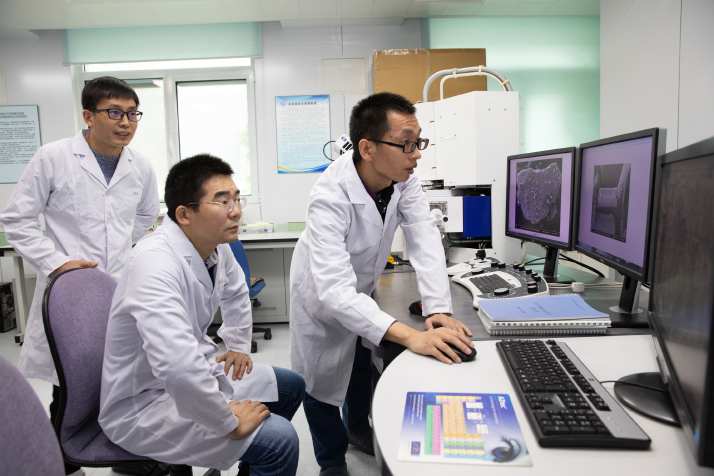
The number of patent applications made under the Patent Cooperation Treaty (PCT) increased from 19,000 in 2012 to 69,500 in 2021, ranking first in the world for the third consecutive year. The PCT allows intellectual property holders to protect their rights in different countries by filing a single international patent application. The number of invention patents per 10,000 people in China grew from 3.2 in 2012 to 19.1 in 2021.
“China has changed from a big importer of intellectual property rights (IPR) to a big IPR-creating country,” Shen Changyu, head of the China National Intellectual Property Administration, said at a press conference on April 24. “The quality of intellectual property creation in China has been continuously improved, the level of protection has been significantly enhanced, and patents have been put into use at an increased pace.”
“Last year, China granted 690,000 invention patents, bringing the total number of invention patents granted over the past five years to 2.53 million, and achieving an average annual growth of 13.4 percent,” Shen added.
The value of technology contracts in China in 2021 was 5.8 times that of 2012, accounting for 3.26 percent of GDP. The proportion of scientifically literate citizens in the country increased from 3.27 percent in 2010 to 10.56 percent in 2020.
Milestone achievements
“The recent decade has witnessed the greatest progress in engineering science and technology, and the fastest improvement in scientific and technological strength in China,” Li Xiaohong, President of the Chinese Academy of Engineering, said at the press conference on June 6.
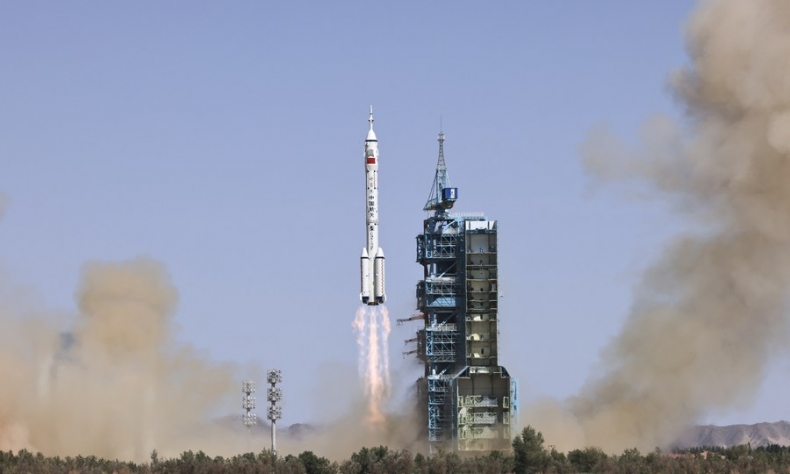
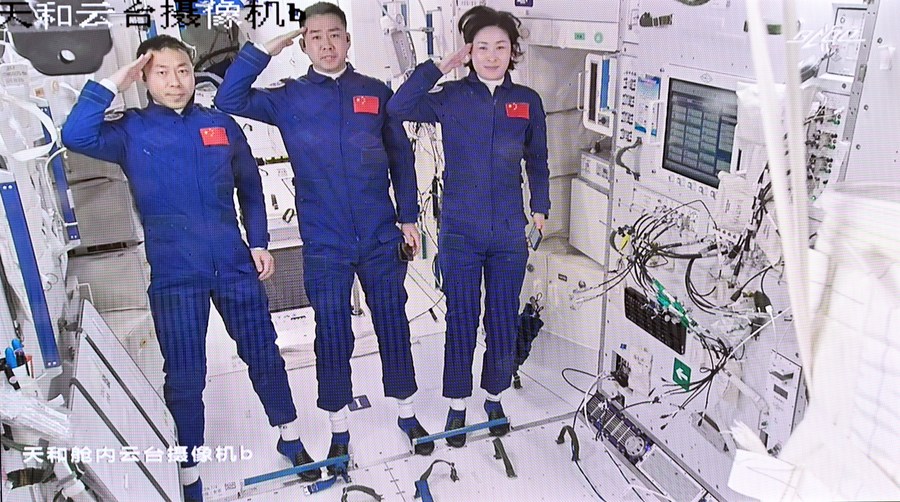
Scientific and technological breakthroughs are constantly emerging. Most recently in June, the Shenzhou-14 spacecraft ferried three Chinese astronauts to China’s permanent space station for a six-month stay. Construction of the space station is scheduled for completion by the end of this year.
Other fields, too, have seen notable recent progress. For instance, at the end of this May, Shanghai Ruijin Hospital began clinical trials of the first home-grown proton therapy device with a 180-degree rotating gantry, which will significantly lower treatment costs compared with using imported devices.
Proton therapy sends beams of high energy that can target tumors more precisely with less damage to healthy tissue and milder side effects than X-ray radiation. It is usually painless, and especially suitable for the treatment of tumors in sensitive areas such as the brain, eyes and heart, and tumors in children. Most patients do not need to be hospitalized and can return to their daily activities after receiving treatment.
The recent clinical trial showed positive results. “Our proton therapy has reached an internationally advanced level,” said Dai Zhimin, Director of the Shanghai Institute of Applied Physics under the Chinese Academy of Sciences. Ruijin Hospital will continue the research and development of a 360-degree rotating beam treatment system in the future, according to him.
China’s scientific and technological innovation focuses on four main aspects—exploring global scientific and technological frontiers, serving main economic sectors, meeting major national needs, and improving people’s life and health. These four focuses were put forward by President Xi Jinping on September 11, 2020.
In terms of exploring global scientific and technological frontiers, China has made a number of original achievements with global influence.
According to MOST, in the past decade, China has made the world’s first observation of the three-dimensional quantum Hall effect and the controlled folding of graphene with atomic-level precision, and developed the world’s first heterogeneous fusion brain-like computing chip Tianji. It has successfully carried out the Chang’e lunar exploration program, and launched the Zhurong Mars rover and Xihe solar observation satellite, as well as several other scientific experimental satellites, including Wukong to explore dark matter, Mozi to perform the first quantum communication between a satellite and the Earth, Huiyan to measure the energy level of a newly discovered gravitational wave, and TanSat to track greenhouse gases in the Earth’s atmosphere.
MOST estimates that the contribution rate of science and technology to the national economic growth exceeded 60 percent in 2020, up from about 40 percent a decade ago.
Wang said science and technology drive industries to move up to the middle and high end of industrial and supply chains, and ensure the safety and stability of these chains. At the same time, emerging technologies such as supercomputing, artificial intelligence, big data and blockchain have promoted the vigorous development of new industries and new business formats such as the digital economy.
To meet major national needs, efforts have been made to speed up research on core technologies and to shore up weaknesses in strategically important fields. Cutting-edge solutions supported the implementation of major engineering projects such as the Hong Kong-Zhuhai-Macao Bridge and the Sichuan-Tibet Railway. The clean and efficient utilization of seabed oil and gas resources and coal, as well as the development of new-generation nuclear technologies, are vital to guaranteeing national energy security.
During COVID-19, China has achieved a number of breakthroughs in vaccines, drugs, and testing reagents, which have strongly supported the prevention and control of the pandemic. Innovative drugs, domestically developed high-end medical devices, and advanced diagnosis and treatment technologies have all been produced in recent years.
According to MOST, thanks to new-drug development projects, the number of approved new Class-I drugs in China has increased from five before 2012 to the current 79. Meanwhile a number of domestically produced high-end medical devices, notably the positron emission tomography-magnetic resonance (PET-MR) system, have been put into use. PET-MR is one of the most advanced medical imaging diagnostic devices across the world.
Innovation drivers
A number of factors are driving China’s science and technology progress, including?increasing government and corporate expenditure and extensive reforms.
Over the period from 2012 to 2021, China’s gross domestic research and development (R&D) expenditure grew from 1.03 trillion yuan ($153 billion) to the world’s second largest of 2.79 trillion yuan ($414.3 billion), according to MOST. The ratio of R&D spending to GDP rose from 1.91 to 2.44 percent, close to the average level of members of the Organization for Economic Cooperation and Development.
Basic research expenditure in 2021 was 3.4 times that of 10 years ago, accounting for about 6.09 percent of total R&D expenditure, a record high for China. “The level of basic research in China has been greatly improved, and that in disciplines such as chemistry, materials science and physics stands at the forefront of the world,” Wang said.
“The proportion of basic research investment in developed countries is mostly at the level of 13-25 percent, so we still have a big gap to close,” Liu Huifeng, a researcher with the Chinese Academy of Science and Technology for Development, said.
Meanwhile, as the number of hi-tech enterprises soared from 49,000 in 2012 to 330,000 in 2021, these enterprises have also increased their R&D spending to now account for more than 76 percent of the national total.
A number of internationally competitive technology-based enterprises have emerged. Huawei, a leading global telecom solutions provider, is also a leader in R&D investment. In 2021, the company invested 22.4 percent of its annual revenue in R&D, the highest level in the past decade, Song Liuping, Huawei’s chief legal officer, said at a forum on June 8. Currently, its R&D investment ranks second among global companies. One seventh of its R&D funding, or about 200 billion yuan ($30 billion), was spent on basic research last year.
According to the company, as of late 2021, Huawei held more than 110,000 active patents across over 45,000 patent families, and it has had more patents granted than any other Chinese enterprise.
Fan Zhiyong, head of the company’s Intellectual Property Rights Department, said the company had been the one to submit the largest amount of PCT applications in the world for five consecutive years until 2021. Last year, the number was close to 7,000, a record high for the company.
In addition to pumping more money into science and technology development, China has been carrying out reforms to spark innovation.
Wang said that cultivating talented people is critical for driving development. “The 10-year innovator-centered reforms have remarkably improved the mechanisms for training, utilizing, evaluating, motivating and engaging talented individuals.”
Project planning and funding management approaches have been updated to simplify the application process and improve fund-using efficiency, and research integrity has been fostered to create a sound environment for?innovation.
Science and technology personnel engaged in basic research, technological innovation, achievement application, and those in hi-tech industries are evaluated by different criteria.
The Law on Promoting the Transformation of Scientific and Technological Achievements was revised to endow innovators with the right to use, dispose of and benefit from the commercialization of their research as much as possible. A number of relevant platforms have been formed, including makerspaces, and science and technology incubators.
Efforts have also been made to build national laboratories and high-level research-oriented universities, and improve the research capabilities of research institutes.
Moreover, over the past decade, China has established scientific and technological cooperation relations with 161 countries and regions, and joint research in the fields of climate change, food security, human life and health has yielded fruitful results. Wang said openness and cooperation are essential to the development of science and technology and indispensable to addressing global challenges.
With all these achievements, Wang pointed out there is still much room for future development. “We are soberly aware that China still lags behind advanced countries in original innovation, cultivation of high-caliber researchers and key core technologies,” he said. “We should not only seize important development opportunities, but also be ready to deal with future risks and challenges.”