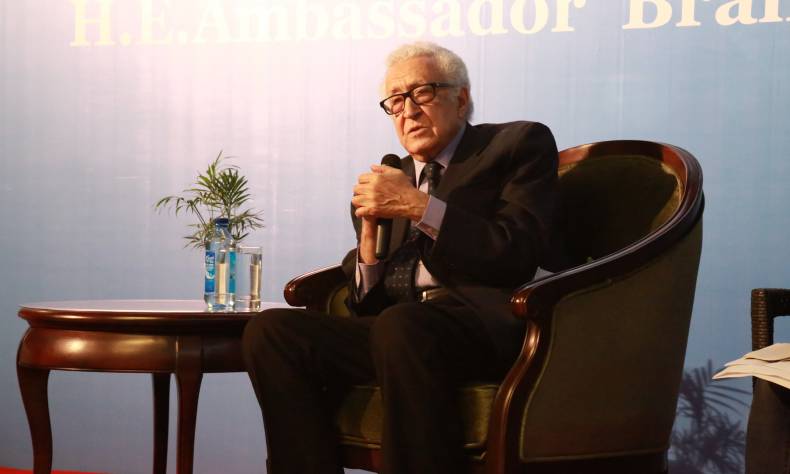
An Evening with Lakhdar Brahimi
 Linkedin
 Google +
In a career spanning sixty years as a diplomat, Lakhdar Brahimi has seen it all. From his time as the Foreign Minister of Algeria to postings as a United Nations Special Envoy in South Africa, Haiti, Afghanistan, Iraq, and most recently in Syria, Ambassador Brahimi has worked his entire life towards a goal of global peace. On November 9, the ambassador spoke to a small gathering of journalists at the Beijing offices of the China International Publishing Group about the Syrian conflict and the small glimmer of hope for the future that has come from the recent peace talks in Vienna.
On the failings of the UN member states, some more so than others:
The most important mission of the United Nations to keep, or try and keep, to preserve, peace and security, and when peace is broken to try and restore it. That is why the United Nations exists.
It is a very, very big responsibility. And a few people try and move the responsibility to the Secretary-General, but in fact the Secretary-General has a very different responsibility. The responsibility [for peace] is with the member states, not the Secretary-General.
So, as you know, I was involved in many of these situations of conflict, and we have made progress only when there was real, strong support from the member states, and especially the important countries, and especially the permanent members of the Security Council.
In Syria, for example, which is now probably the most important crisis not only for the Syrian people or the region but the entire world. In Syria, Kofi Annan first and myself after him, we have tried everything we know to help the Syrian people out of their conflict, but we have not succeeded.
On the conflict and the lack of cooperation:
All conflicts are different. Syria is different from Afghanistan, Afghanistan is different from Sudan, Sudan is different from the Congo, and so on. In Syria, the first responsibility, the biggest responsibility, lies with the government. This is a government that has been in power from the father first and then the son for forty years. For exactly 40 years in 2011, when the crisis started.
The first demonstrations that have taken place were done by teenagers, kids of 13-, 14-, 15-, 16- years-old. The oppression was extremely brutal. For several months, in spite of the repression and use of force by the government, the demonstrations’ slogan was mainly “peaceful, peaceful, peaceful.”
And then the country plunged into civil war. Unfortunately the countries which intervened did not intervene to make peace. They intervened to support, to continue the war.
Roughly speaking, Russia and Iran were supporting the government, and the United States, Western Europe, especially Britain and France, as well as the main countries in the region, especially Turkey and Saudi Arabia, were supporting the opposition. Both sides were supporting the war.
Kofi Annan first and myself after, together with Ban Ki-moon, were saying that there is no military solution, only political solution.
So, our power, our language, was not acceptable to any of the parties. The government said “We are the legitimate government. These are rebellions. First of all, don’t interfere. Second, it is our duty to reestablish peace and order, and if necessary, we will do it with military force, as the state has the right to.”
The opposition, and those who supported the opposition, were saying that “the government, because of the brutality of its repression, has lost its legitimacy, and therefore we need change, and we need to replace this government. Let this government go away, and we will talk. But not before.”
And each side was saying “We are going to win eventually.” The President of Syria told Foreign Minister [Sergey] Lavrov of Russia in the summer of 2011 “Give us three weeks. In three weeks, everything will be straightened out.”
And those three weeks have lasted four years.
Meanwhile, the opposition was saying exactly the same thing: “Assad is going to run away in a matter of weeks.”
And those weeks have also lasted for years.
On the recent talks and the refugee crisis:
The population of Syria is about 23-24 million, and half of the population has been displaced. Between 4 and 5 million are refugees outside of Syria, and another 7 to 8 million are interminably displaced, roaming around from one place to another. The country has been completely destroyed.
You could say that perhaps a year ago everyone stopped saying “we are going to win,” and everyone started saying that there is no military solution, only political solution.
But in fact, everyone continued to work for military solution, not a political solution. Until two weeks ago. Two weeks ago there was a meeting in Vienna. The first meeting of Russia, America, Saudi Arabia, Turkey, and then the second meeting one week later of the P5 including China plus Iran and other countries from the region, and now it does look like these people are talking seriously about a political solution.
So, there is room now for very, very guarded optimism. Not optimism, but hope. A little hope.
In the meantime, the fighting continues, destruction continues, and there is this new phenomenon of Syrian refugees, along with refugees and migrants from other countries, including from Afghanistan, Pakistan, and Africa are now appearing in Europe.
There is now a great deal of interest in the media, including in the Chinese media, in the issue of refugees from Syria and elsewhere. When I saw your journalists, and they raised this issue of Syrian refugees in Europe, I told them that it was terribly unfortunate that it is only now very important, that a lot of attention is being paid, because the refugees have reached Europe.
These refugees have reached Europe this summer, just a couple of months ago. In Jordan, in Turkey, in Lebanon, there are millions of refugees, and there have been millions of refugees for the last four years. Lebanon is a tiny country, geographically it is very small, and its population is just 4.5 million. They have almost 2 million refugees, and they have had those refugees for a long time, but no one has paid attention. But when 300,000 refugees reach Europe, the whole world is now worried. In Europe, there are 28 countries, and it is big news? Lebanon has two million. If you translate that proportionately for China, that would be 600 million refugees in China. So, what would you do if you had 600 million refugees?
In Syria, it is a terrible disaster. The Syrian people are the victims of a terrible injustice. Injustice by their government, injustice by their neighbors, and injustice by the international community.
Ban Ki-moon said several times that we have failed the Syrians. He doesn’t mean himself. He means the international community. We have let the Syrian people suffer this injustice, they have done nothing to deserve this, for now almost five years. And most of us, the Chinese, ourselves, the Pakistanis, we haven’t done anything. And a lot of other people have actually thrown oil on the fires, making the problem much worse.
On Russian intervention and global responsibility:
The Russian direct intervention is recent. I think it is, at least for me, it is too early to say how positive and helpful it is going to be, or how negative. It has certainly helped create conditions for movement. These meetings in Vienna owe a great deal to the Russian intervention. It is because of Russian intervention that these meetings are happening. So, if these meetings lead to peace, it is great and Russian intervention will have worked. If it doesn’t, there is reason to wonder if it is going to be like the Soviet intervention in Afghanistan in 1979. Remember, Brezhnev said in 1979 almost the exact same thing as Putin today. “We are moving in to help the legitimate government of Afghanistan…We are going in to help the legitimate government of Syria.”
It didn’t work very well in Afghanistan, so I hope it will work much better in Syria.
I said in the beginning that the first party who is responsible is the government. The government is supposed to keep the peace and security, so the government must be responsible for some of it, but one must add that ISIS – the Islamic State of Iraq and Syria – that is the direct result of American aggression against them. It was first the Islamic State in Iraq, and only in Iraq, and then it expanded into Syria because Syria was in crisis. It has seen the light of day in Iraq as a direct result of the U.S. occupation and the distraction of the state.
So, there is a lot of international responsibility, and there is a lot of local and regional responsibility. And as I said, the Syrian people are the innocent victims of a lot of injustices from a lot of side. There is a glimmer of hope because of the process that has started in Vienna. Let’s hope it will produce better results than Kofi Annan and myself.
Questions from the press:
China Today:
My first question is about Arab states in the Middle East, and Arabs in general. Do you think Arabs are one united nation or ethnicity? If they are, why are they so divided? Why is there so much conflict in the region? My second question is to do with ISIS. How did the organization grow to such a huge scale?
Ambassador Brahimi:
You know, the Arabs are very quarrelsome. We speak the same language, most of us are Muslim, around 90 percent of us are Muslims, but we are different countries with quite different backgrounds, situations, regimes, and you quarrel with your neighbor. You don’t quarrel with people who are far away from you. Maybe we quarrel a little bit more than others, but there is a strong sense of kinship there at the same time.
ISIS did not exist in Iraq or in Syria before the U.S. intervention in Iraq in 2003. When the Americans invaded Iraq, there was understandably resistance to the occupation. That resistance was strongly reinforced by the dissolution of the Iraqi army. Iraq had an army of almost half a million men, and all of a sudden they found themselves on the streets, with no pay, no pension, no future, and their country occupied. Many of them started fighting against the occupation. That is now 12 years ago. In those 12 years, many of these members of the army have joined hands with other groups who are fighting against foreign invasion. Some of the groups are Islamists or extremists. They and the army have joined hands. The extremists, the Islamic fundamentalists, they brought the ideology, and the military brought military experience and capacity. When this was taking place in Iraq, nobody was talking a great deal about it. You know, after 3 years of crisis in Syria, and the breakdown of the state in Syria, the Islamic State of Iraq expanded into Syria and they changed their name to the Islamic State of Iraq and Syria.
Beijing Review:
Will the Syrian crisis evolve into a proxy war? You called it last time we met a “parallel war,” but looking at the history of those two countries, Russia and the United States, backing the opposite sides of a civil war in a sovereign state, this is what they do. Do you think peace is possible with the mediation of your successor?
Ambassador Brahimi:
There is, yes, a proxy war. Iran and Saudi Arabia are fighting a proxy war. There are lots of people who are in Saudi Arabia and in Turkey, who are financed and armed by Saudi Arabia and Turkey, they are fighting people who are armed and financed by Iran. This is one war, so far. The Americans are supporting Turkey, Saudi Arabia, and the rebels inside Syria. Russia has been supporting the government for quite some time, now they have military presence. Are we going to have a proxy war between America and Russia? I don’t know yet. The Americans are fighting together with their allies against the government and against ISIS. Russia is supporting the government and fighting also against ISIS. So the Americans and their allies, Russia and its ally the government, are fighting ISIS separately. They are discussing the possibility of cooperating, but until now they are fighting separately. This is where we are right now. One hopes that rather than moving forward towards more confrontation, we would move towards peace through these new processes that have started. But we don’t know yet. That is why I say we have proxy and parallel wars at the same time.
China Matters:
It seems that within the UN Security Council there is a divisiveness driven by political agenda, loyalty to allegiances, and general mistrust. How great a problem is this, not just with regards to the future of Syria, but to the future of the Security Council itself?
Ambassador Brahimi:
Look, if the P5 is not united, the Council is totally paralyzed. On Syria, they have been divided, and therefore they have not been able to contribute in any serious manner.
The world is becoming smaller, and people know who is doing what and how serious every country is when resolving issues. If there isn’t a strong, united political will among the P5, people realize that the P5 will not do anything.
This is a very serious issue that has been discussed since the end of the Cold War, and some people have been saying that the Security Council is like a student organization, that they sit and discuss and sit around but don’t make any serious decisions.
They have made a series of resolutions, they are making a resolution every other day, but they are making in a totally irresponsible manner.? The worst of these decisions was in Srebrenica. I am sure that you have heard of it. The Security Council created a zone, a safe area. That means if you went there, you had nothing to fear. So people went to Srebrenica [in Bosnia and Herzegovina], which was a safe area, and 7,000 people were killed. The Security Council, with a unanimous vote, said “Come here, you have nothing to fear. You will be protected.” So the people went there, they were killed, and the Security Council did absolutely nothing. Not only have they failed to do their work, they were irresponsible to create a zone and say it is safe, then do nothing to protect them. So, there are problems.
China Matters:
Do you think that China has done enough in the Middle East? Is China doing enough?
Ambassador Brahimi:
You know, this morning we discussed these issues with some of your professors at Peking University. Before we started this discussion with the professors, I thought like you, that China is not doing enough politically. But the professors explained to me, to us, very convincingly that China has grown very fast, and politically they are a little bit careful. Also, China’s priorities are closer to home. The Middle East is a little bit too far, it is not terribly important for China, and also the Chinese are not absolutely certain how welcome they are by the various governments or by the Arabic world.
I still believe that China is a very important power in the world, and I am disappointed to hear the Middle East is not a priority. It should be a priority because it is a very, very big problem for the international community. I think China can and should play a bigger role in international affairs.
Ambassador Brahimi is a good man who has spent his life fighting the good fight, and that must be exhausting. The ambassador is right when he says the world has got to do more, that the Syrian people did nothing to deserve this and yet we, as an international community, are turning our backs on them. China needs to do more (despite the old “China is a developing nation” chestnut), the U.S. needs to do more, Europe, Australia, Canada, New Zealand, Japan…anyone saying that these refugees will struggle to assimilate because there are no mosques (as talk show host John Oliver said, “You know you can build mosques, right? Mosques don’t naturally occur in the wild through erosion or particularly devout beavers”) or other such comments is simply sticking their head in the sand as thousands flee a land on fire, a land once their homeland that they may never see again. That is too sad and unacceptable in a world supposedly this advanced.
On that note, John Oliver on refugees and migrants:










China should do more? Do you know how many problems it has on its own? Now other world places are in danger due to some other country’s fault and you expect China to be the god. That is ridiculous. Which country can China count on when it was under attack and invasion from the 1840s, even before the WWI and WWII?
Wow. I am just ‘Brahimi’ with excitment to attend that event. China can definitely afford to do more – the world’s second largest economy!