Reciprocal Respect Over Rivalry
 Facebook
 Twitter
 Linkedin
 Google +
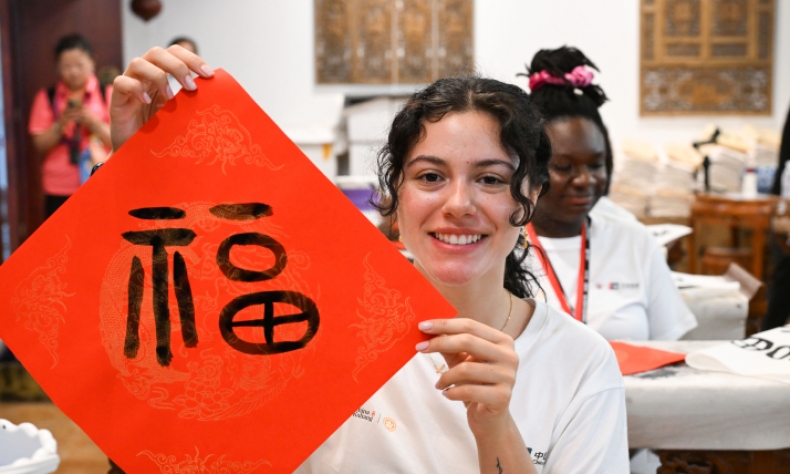
The move toward multipolarity, driven by China’s rise, creates a more balanced and potentially harmonious world order, challenging the zero-sum logic that has defined Western hegemony.
Corinna Mullin, adjunct professor of Political Science at John Jay College, City University of New York, the U.S., recently made her first visit to China. In an exclusive interview with Beijing Review reporter Li Wenhan, she shared her initial impressions of the country, comparative observations on China-U.S. differences, as well as perspectives on the prevailing narrative in the U.S. that portrays China as a global rival requiring containment. Edited excerpts from their conversation follow:
Beijing Review: Could you share your experiences during your recent visit to China? From your observations, what similarities or differences stand out between China and the U.S.?
Corinna Mullin: It has been a truly wonderful and eye-opening experience. I have spent close to two weeks traveling across several regions, visiting Northwestern University in Xi’an, Fudan University in Shanghai and the historic city of Yan’an, Shaanxi Province, where I learned about the culmination of the Long March, an event I had only read about before. At Fudan University, I had the privilege of teaching at the Summer School, which provided a valuable opportunity to interact directly with students here.
The enthusiasm and curiosity of the students reminded me of my own students in New York, and I could not help thinking how beneficial it would be for them to experience China firsthand. Visiting these institutions, walking through campuses and engaging in discussions gave me a far deeper understanding of the country. It was also an opportunity to witness China’s development and social atmosphere in a very direct and personal way.
The differences between the two countries are striking. China feels as though it is operating in the 21st century—efficient, modern and well-organized. The infrastructure here is exceptional. During my stay in Shanghai, I lodged in a hotel where robots delivered items directly to guests’ rooms. Public transportation systems, from high-speed trains to subways and buses, run with remarkable punctuality and safety. Streets are clean, urban spaces are vibrant and there is a clear sense of public order.
By contrast, arriving in New York, whether at LaGuardia or JFK Airport, one immediately notices the deterioration of infrastructure. The highways are in disrepair, the subway system suffers from years of underinvestment and, overall, the urban environment reflects what some scholars have called “organized state abandonment.” In the U.S., this means the state functions largely to serve the interests of the wealthy and elite, while neglecting the needs of the broader population.

Social life also differs markedly. In China, there is a strong sense of community cohesion. Even late in the evening, public squares are filled with people, especially the elderly, dancing, exercising or enjoying music together. Children and seniors are visible and active throughout the day. In the U.S., particularly in New York, homelessness is widespread and public spaces often reflect deep social inequalities. Such community vibrancy is rare in American urban life today.
The contrast of wealth distribution could not be sharper. In New York, often described as the richest city in the world, approximately 40 percent of students at the City University of New York, where I work, are food insecure, meaning they miss at least one meal per day. This is happening in a city whose GDP exceeds that of many countries, which makes it not just an economic issue. The root problem lies in how wealth is distributed.
In China, the distribution of wealth is organized in a way that prioritizes protecting the population and safeguarding the wellbeing of the masses. The most remarkable achievement, in my view, is the lifting of 800 million people out of extreme poverty (as of late 2020—Ed.), a feat unparalleled in human history. This demonstrates a clear policy commitment to the majority of citizens, not just the wealthy. Such an accomplishment offers valuable lessons for other nations, particularly in terms of development models, governance structures and the alignment of economic systems with social welfare goals.
Do you see China’s rise as a “challenge” to U.S. dominance in global economic governance?
The rapid economic and technological rise of China is one of the reasons for the U.S.’ increasingly aggressive posture. This shift did not begin with the Trump administration, though it accelerated during his first tenure. We can trace it back to the Obama administration and the so-called “Pivot to Asia,” which explicitly aimed to reorient U.S. foreign policy and military focus toward East Asia and China.
At the heart of this tension lies the fact that Western monopoly capital, built over centuries on colonialism, slavery and the extraction of resources from the Global South, has long been accustomed to dominating global markets. The expectation among U.S. policymakers was that China would remain at the lower end of the global value chain, producing low-cost inputs while high-value activities remained concentrated in the West. Instead, China not only advanced technologically but, in many areas, surpassed U.S. capabilities. This fundamentally disrupts the established order that has benefited the West for generations.
China’s growth has enabled many states to pursue more autonomous development paths, reducing dependence on Western-controlled systems such as the SWIFT banking network. Countries facing U.S. sanctions can now seek alternative trade partners, conduct transactions in local currencies and develop regional economic frameworks outside the Western orbit.
For Western elites and monopoly capital, this trend is alarming. Their dominance has always been maintained not through free markets, despite the rhetoric, but through systems of control backed by state intervention, military force and economic coercion. These include colonial exploitation, imperialist interventions and, more recently, the weaponization of sanctions. The move toward multipolarity, driven by China’s rise, creates a more balanced and potentially harmonious world order, challenging the zero-sum logic that has defined Western hegemony.
What should China and the U.S. do to ensure lasting peace?
My expertise is in U.S. foreign policy, so I can only speak from the American perspective and would not presume to tell China what course it should take. However, the foundation must be mutual respect. For too long, U.S. foreign policy has been rooted in domination, control and often racial prejudice. A genuine foreign policy reorientation is needed, one that ends imperialist practices and acknowledges the sovereignty, history and achievements of other nations, including China.
Many Americans, if they experienced China as I have, might see it as a potential model for how a state can serve its people. In the U.S., especially for working-class communities of color, interaction with the state often takes the form of repression rather than support. By contrast, China’s investment in infrastructure, education, healthcare and green energy illustrates a different approach, one oriented toward public welfare and sustainability.
For genuine peace, the U.S. must respect international law, support reforms to global institutions so they reflect the voices and needs of developing nations and historically marginalized states, and engage in equitable trade and economic exchanges. The U.S. should abandon its role as self-appointed global policeman and instead see itself as one state among many, cooperating to address shared global challenges such as climate change, economic inequality and public health crises. I think if that were to happen, we would have a much more peaceful world.