Bonds Beyond the Bund
 Facebook
 Twitter
 Linkedin
 Google +

I’m quite optimistic that, despite all the challenges, there will be plenty of opportunities for both sides to collaborate—not only in confronting climate change, but in tackling a broader set of global issues together.
Over the past century, the American Chamber of Commerce in Shanghai (AmCham?Shanghai) has borne witness to the shifting landscape of China-U.S. trade relations. In an exclusive interview with?Beijing Review?reporter Peng Jiawei, Eric Zheng, President of AmCham Shanghai, shared his views on the past, present and future of bilateral economic ties—from their historical roots and current challenges to prospects for renewed cooperation. Edited excerpts of their conversation follow:
Beijing Review: This year is AmCham Shanghai’s 110th anniversary. How has the chamber evolved alongside China-U.S. trade relations over the decades?
Eric Zheng: In 1915, 45 American businessmen gathered at the Palace Hotel—now known as the Peace Hotel—on the Bund, then the heart of Shanghai’s foreign business community, and decided to establish the American Chamber of Commerce.
It was the third AmCham overseas, after Paris and Manila—a decision that was not all that surprising given the growing number of U.S. businesspeople that were based in Shanghai back then.
Even in the early 20th century, a host of U.S. firms, such as Citibank and American Express, were already quite active in the city. In those early years, the chamber served as a network that allowed businesspeople to socialize with one?another.
We left in 1950, but returned in 1987, as China began opening up to the outside world. Many U.S. companies started to invest in China, and there was a clear sense among them that it was time to re-establish AmCham.
Our new mission in the current era is to help our members stay informed, connect with each other and navigate the growing impact of policies and regulations on business operations.
In a rapidly changing environment, particularly amid the ongoing trade war and the shifting tariffs, it is more important than ever that we perform our role, which is to connect, advocate and inform.

How would you describe the status quo of China-U.S. trade relations? And to what extent does China still matter for U.S. businesses today?
At a fundamental level, the two economies complement each other. Just look at the trade flows between them: China remains one of the largest export markets for the U.S.—same goes for the other way around.
There are certainly challenges, most of which are structural. The U.S. imports far more from China than it exports, which has led to a trade deficit of roughly $300 billion. That’s in goods, of course. When it comes to services—particularly in areas like education and tourism—the U.S. actually runs a surplus.
On the other hand, China tends to consume less than it produces. So both sides face structural issues that need to be addressed in order to work through their differences.
The good news is that the two sides are talking. And a major platform where dialogue and exchange is happening is the China International Import Expo (CIIE). (Held annually in Shanghai from November 5 to 10 since its inception in 2018, the CIIE is the world’s first national-level expo focusing exclusively on imports—Ed.)
In partnership with the U.S. Department of Agriculture, AmCham Shanghai has participated in the CIIE for two consecutive years by hosting the American Pavilion, which was focused on introducing U.S. agricultural products.
The results have been substantial. In our first year, we signed over $500 million in contracts in less than one week. Last year, that figure rose to $711 million.
This year, the pavilion will return with a continued emphasis on agricultural products. Why agriculture in particular? The U.S. is one of the world’s largest agricultural exporters, while China is a major importer of such products. So there is a complementary relationship right there.
Historically, the U.S. sells about $30 billion worth of agricultural products to China each year. That number fell in 2024 due to a mix of geopolitical factors. Still, we are hopeful we can help U.S. farmers boost exports, especially soybeans, which China continues to need in large quantities.
There’s also growing interest in other categories, such as pet food, where demand has been soaring in China as more young people keep pets and care deeply about their wellbeing.
With that in mind, we are working to introduce a broader range of products to this year’s CIIE. My hope is that, through efforts like these, China and the U.S. can continue to find common ground—areas where both countries can grow together.
How are members of AmCham Shanghai responding to growing calls in the U.S. for “de-risking” and “decoupling” from China?
Choosing to invest in China is, for many, an easy decision. But the downside is that you may become overly reliant on a single country for?production.
That’s why many of our members are?pursuing the so-called “China plus one” strategy—keeping China as their primary source of products and services, while also developing an alternative, just in case.
The move to increase business resilience is certainly underway. But companies are not leaving China, which remains a deeply strategic and significant market for most of our members.
Indeed, the Chinese market is huge, driven by one of the world’s largest populations—second only to India—and a rapidly expanding middle class. Therefore, many of our companies are in China for China: They manufacture here, sell here and design their products specifically for the Chinese market.
That’s number one, the market itself. The second major factor is China’s manufacturing capacity.
Over the past decades, China has built up a manufacturing ecosystem. You have the infrastructure, the production capacity, the talent, the workers, the natural resources and very supportive government policies. That’s a total package.
Other countries, such as those in Southeast Asia or India, can do parts of that, but they’re not quite there yet.
People talk about “friendshoring, nearshoring and reshoring.” (“Friendshoring” is a business strategy where companies shift their production and supply chains to countries that are considered political and economic allies; “nearshoring” is the outsourcing of business processes to companies in a nearby country; “reshoring” is the practice of bringing manufacturing back to a company’s home country—Ed.) But you just can’t find another country that can replace China from a sourcing perspective.
I’d go even further and say that in the next five or 10 years, it will be very hard to find another country like China. That’s why our companies remain committed to the Chinese market.
How do you see China-U.S. trade relations evolve in the coming years?
I still believe there’s room for the two countries to work together commercially and find ways to support each other.
As China continues to open its market to foreign investment, its negative list is steadily shrinking. (A negative list is a list of sectors and activities that are off-limits to both domestic and overseas business entities—Ed.) When it first introduced the negative list system, there were more than 190 restricted categories—now there are fewer than 30.
With the continuous shrinking of the negative list, new opportunities are opening up—particularly in the financial services sector. Whether it’s banking, insurance or securities, U.S. companies are among the global leaders. If they can bring their strengths to the Chinese market and help Chinese companies grow, it will be a win-win for both sides.
Beyond commercial activities, we’re hoping that the two countries can work together to tackle global challenges such as climate change, public health and AI governance.
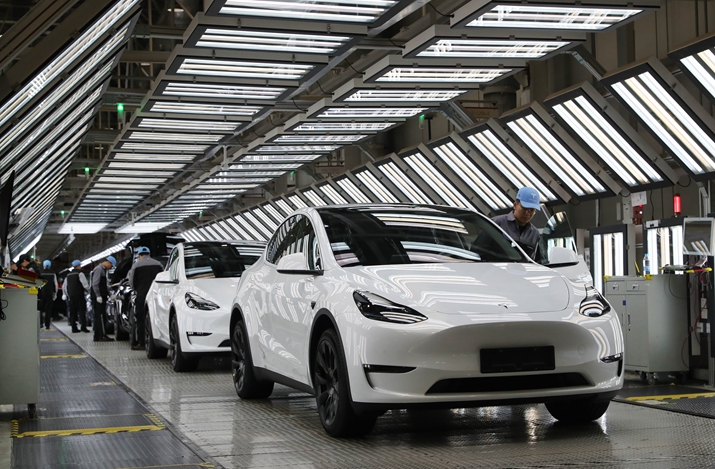
Take climate change as an example. There are so many areas within the sector where we can deepen collaboration. When it comes to new-energy vehicles, you’ve got BYD and other major players; CATL is leading globally in lithium-ion batteries. Green energy is another promising area, and I was very pleased to learn that Tesla, one of our members, has already launched its energy storage project in Shanghai, in addition to its gigafactory.
The situation is evolving. When we re-established AmCham Shanghai in 1987, China wasn’t that developed yet. In the 1980s, U.S. companies could bring their products and services into the country and easily find success.
But now, there is a lot to learn from our Chinese partners, many of whom are highly?innovative.
I’m quite optimistic that, despite all the challenges, there will be plenty of opportunities for both sides to collaborate—not only in confronting climate change, but in tackling a broader set of global issues together.