History Facts Show Why Uygurs Are Member of the Chinese Nation Family
 Facebook
 Twitter
 Linkedin
 Google +
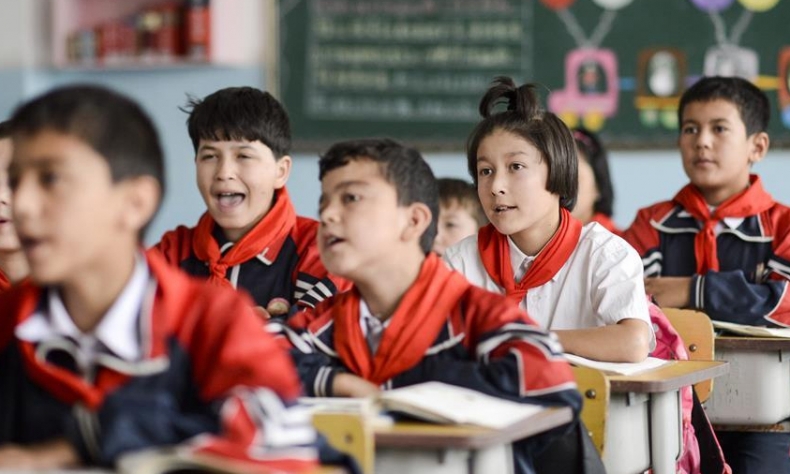
It is the integration and continuous development of various cultures that have created the splendor and brilliance of the Chinese civilization of 5,000 years, which demonstrates the strong sense of cohesion of the Chinese nation.
Xinjiang has been a multi-ethnic area since ancient times. The Uygur people came into being through a long process of migration and integration. The Uygur people have no other relations with Turkey except that their language also belongs to the Turkic languages (branches of the Altaic languages). The Uygur people are not descendants of the Turks, let alone being their “brothers”.
Xinjiang has been home to multi-ethnic people since long ago
Since ancient times Xinjiang has been home of multiple ethnic groups in China. Xinjiang had 13 ethnic groups with a long history, including the Uygur, Han, Kazakh, Hui, Kirgiz, Mongol, Xibe, Tajik, Uzbek, Manchu, Daur, Russian and Tatar. Now it hosts 55 ethnic groups including the Dongxiang, Zhuang, Salar, Tibet, Yi and Korean.
Throughout the long history all ethnic groups living in Xinjiang have been closely related and interdependent, jointly developing and building Xinjiang, safeguarding the stability of the borderland, national integrity and solidarity and promoting the development and progress of the country.
Before the Qin and Han Dynasties there was no documentation of ethnicity in Xinjiang. Clear records came only after the Han Dynasty, which mainly included the Sai, Rouzhi, Wusun, Qiang, Xiongnu and Han (Han here refers to people of the Han Dynasty, not the Han ethnic group in the modern sense).
In 101 BC the Han troops began to be garrisoned in Luntai, Quli and other places to open up wasteland, and later expanded to all parts of Xinjiang. Each garrison became the initial entry point of the Han people. After the establishment of the Western Regions Frontier Command in 60 BC, the Han people entered Xinjiang continuously, either as officials, military personnel or businessmen.
The period of the Wei, Jin, Southern and Northern Dynasties was a time of great ethnic integration in China with frequent migration of various ethnic groups. Many of them entered Xinjiang such as the Rouran, Gaoche, Da and Tuyuhun.
During the Sui and Tang Dynasties the Turk, Tubo and other ethnic groups had an important influence on the historical process of Xinjiang. In the mid-8th century, the ?Eastern and Western Turkic Khanates perished one after another, their descendants partly integrating into other ethnic groups. The Western Turkic branch conquered Asia Minor, established Ottoman Turkish Empire and intermarried with local residents, resulting in the Turkish people with both eastern and western characteristics but different from the ancient Turks. The ancient Turks were not equal to the contemporary ethnic groups who speak Turkic languages.

The forefathers of today’s Uygur were the Ouigour people mainly lived in the Mongolian steppe. In 745 AD the Ouigour Khanate appeared in the Mongolian steppe and collapsed in 840 AD. Some Ouigour people moved west to Tarim Basin in southern Xinjiang and gradually merged with local indigenous people to form the modern Uygur ethnic group. The Uygur people have no other relations with Turkey except that their language also belongs to the Turkic language branch of Altaic language family.
In 1124 the royal family member Yelvdashi? of Liao Dynasty led people to move westward, conquered Xinjiang and established the Western Liao regime, from which a group of the Khitan entered Xinjiang. At the beginning of the 13th century after Genghis Khan led his army into Xinjiang, he divided the areas he conquered and passed on to his descendants. The Uighur further assimilated and integrated some Khitan and Mongols.
Wala, the general name of west Mongolians in the Ming Dynasty, first distributed in the upper reaches of Yenisei River, and then continuously expanded to the middle reaches of Erzis River and Yili River Basin. At the beginning of the 17th century Junggar, Durbert, Heshuote and Turhute were gradually formed. In the 1970s, Junggar occupied Yili River Basin, became the head of the four divisions and ruled southern Xinjiang.
After the 1760s in order to further strengthen the border defense in Xinjiang, the Qing government transferred troops of the Manchu, Xibe, Solon (Daur) and other ethnic groups from northeast China to be garrisoned in Xinjiang who became new members of ethnic minorities there. Later the Russian, Tatar and other ethnic groups also moved to Xinjiang.
By the end of the 19th century, there were 13 ethnic groups in Xinjiang, including the Uygur, Han, Kazakh, Mongolian, Hui, Kirgiz, Manchu, Xibe, Tajik, Daur, Uzbek, Tatar and Russian, with the Uygur as the majority, forming the basic pattern of multi-ethnic distribution in Xinjiang today.
At this point the Xiongnu, Xianbei, Ket, Di?, Qiang, Turk, Uygur, Khitan and other ethnic groups that were once prominent in history disappeared. Some of them joined the Han people adding fresh blood to the formation of the Han group while others became the major part of Xinjiang Uygur and other ethnic groups. It not only created the flesh-and-blood relationship between ethnic groups in Xinjiang and between Xinjiang and inland groups, but also kept the “diversified and integrated” structure of the Chinese nation as a prominent manifestation of Xinjiang’s multi-ethnic evolution.
Xinjiang embraces different religions
The history of Xinjiang shows that multiple religions have long coexisted there. At present, there are Islam, Buddhism, Protestantism, Catholicism and Taoism. The evolution of religions in Xinjiang has roughly experienced four stages, namely, the primitive stage, the formation stage in which Buddhism is the major religion, the evolution stage in which Islam and Buddhism were the major religions, and the developmental stage in which Islam is the major religion.
Long before Islam, Zoroastrianism, Buddhism, Taoism, Manichaeism, Nestorianism and other religions had been introduced to Xinjiang along the Silk Road and disseminated around together with native primitive religions. After the introduction of Islam Xinjiang not only maintained the coexistence of multiple religions but also accepted Protestantism and Catholicism.
At the end of the 9th century and the beginning of the 10th century Islam was introduced into southern Xinjiang through Central Asia. In the mid-10th century the Kara-Khanid Kanate, which believed in Islam, launched a religious war against the Buddhist kingdom of Khotan which lasted for more than 40 years and collapsed in Khotan in the early 11th century, expanding Islam to Khotan area. Since the middle of the 14th century Islam has gradually become the major religion of the Mongolians, Uygurs, Kazakhs, Kirgiz and Tajiks under the enforcement of Chagatai Khanate (a vassal state established by Chagatai, the second son of Genghis Khan in Mongolia). At the beginning of the 16th century Islam finally replaced Buddhism as the major religion in Xinjiang.
After Islam became the major religion of the Uygur and other ethnic groups, Zoroastrianism, Manichaeism and Nestorianism, which were originally believed by these groups, gradually disappeared in Xinjiang while Buddhism and Taoism still existed. Since the Ming Dynasty Tibetan Buddhism has made great progress and become one of the two major religions in Xinjiang alongside Islam.
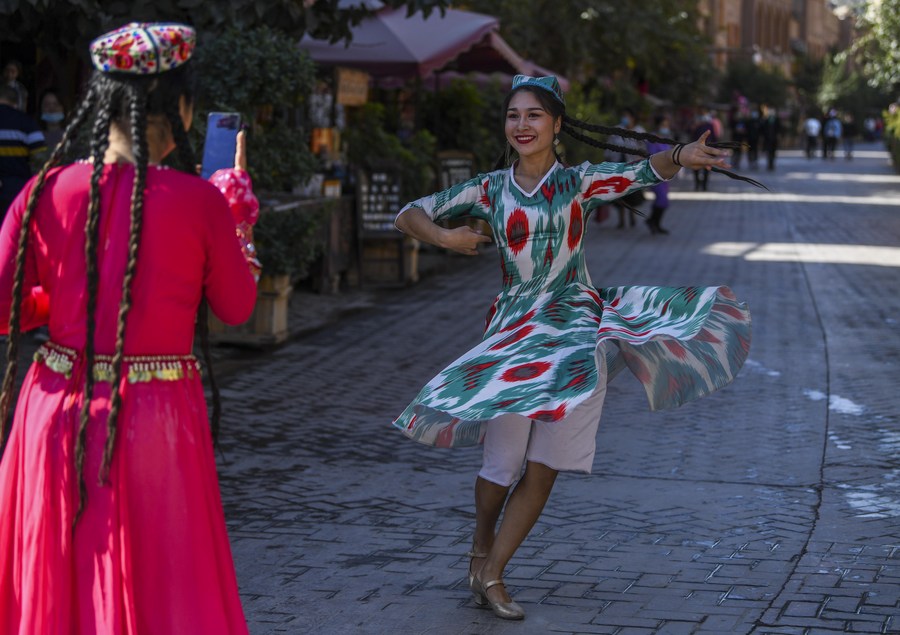
Since the 18th century Protestantism and Catholicism have been introduced into Xinjiang while Buddhism, Taoism and Shamanism have also made great progress. The temples and churches of these religions spread all over the north and south of Tianshan Mountains. Some Muslims even converted to Buddhism, Protestantism and other religions.
The religious history of Xinjiang shows that the Uygur and their ancestors believed in many religions including Islam for only hundreds of years. In history the class struggles were more about ethnic minorities against oppression rather than religious wars.
Although religions in Xinjiang have been constantly evolving, the coexistence of multiple religions has been maintained throughout history. At present, there are mainly Islam, Buddhism (including Tibetan Buddhism), Protestantism, Catholicism and Taoism in Xinjiang. Shamanism still has great influence in some ethnic groups.
The history of Xinjiang shows that multiple religions have long coexisted there, with one or two predominant. The region’s religious structure is characterized by blending and coexistence.
The Chinese nation is family of different ethnic people
The process that foreign enemies turned China into a colony or semi-colony in modern times is also the process that the Chinese people of all ethnic groups defeated ?the same enemy, fought for independence and liberation of the Chinese nation, and safeguarded national unity and territorial integrity.
In the process of saving the nation from subjugation, the Uygur and all other ethnic groups fought against aggression and separation. It further enhanced the awareness of solidarity. The sense of responsibility of people of all ethnic groups sharing the Chinese history has been further stimulated. The patriotism of the Chinese nation has been sublimated. With the deepening of the sense of community of a shared future, all ethnic groups in China are transferring from unconscious unity to consciousness.
In a word, for thousands of years the Uygur ancestors together with other ethnic groups and their forefathers have jointly developed the vast territory of the motherland and created the long history and splendid Chinese culture. In this process all ethnic groups and their ancestors, including the Uygur, frequently and closely contacted to become a unified whole that has become impossible to separate, leading to the formation of a great Chinese nation.
The Chinese nation family is not only a united country maintained by all ethnic groups but also an economic community in which all ethnic groups depend on each other economically. It is more of a cultural community in which all ethnic groups are culturally inclusive. It is the integration and continuous development of various cultures that have created the splendor and brilliance of the Chinese civilization of 5,000 years, which demonstrates the strong sense of cohesion of the Chinese nation.
The author is Uygur historian, President of Hotan Normal College in Xinjiang Uygur Autonomous Region.