New World Economic Model in Formation
 Linkedin
 Google +
Before our eyes, a new social and economic system is being formed that is more effective than the previous ones and the center of world development is shifting to Southeast Asia.
We are currently witnessing a restructuring of the world economy connected with its transition to a new technological paradigm. This is based on unprecedented development in nanotechnology, bioengineering, and information and communication technologies.
It is during such periods of global technological shifts that the lagging countries have the opportunity for economic acceleration toward the level of advanced countries, while the latter are faced with an over-accumulation of capital in obsolete production and technological complexes.
The potential success in these processes can be reached by the dominant countries of Eurasia. This acceleration is already being made today by China and other countries of Southeast Asia. Over the past three decades, China has made impressive advances. From the deep periphery of the world economy, it has leapfrogged into the group of economic leaders, leading the world in terms of physical GDP and exports of high-tech products.

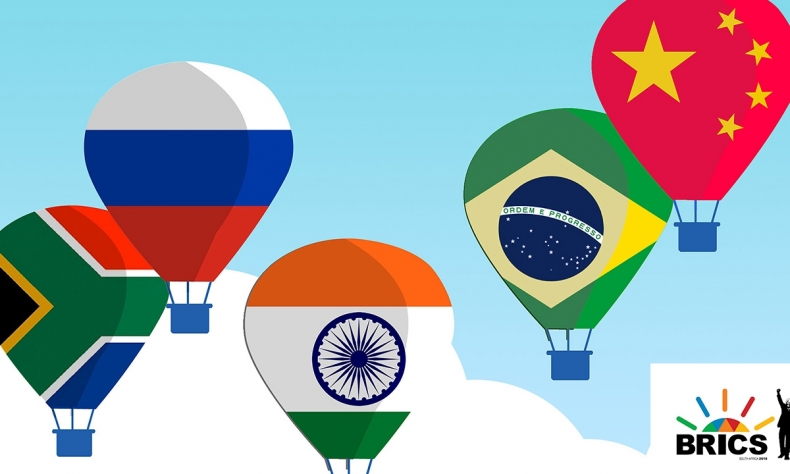
India is also making a powerful breakthrough in development on the basis of a new technological mode simultaneously with China, now leading the world in terms of economic growth rate. Although adherence to the dogmas of the Washington Consensus has significantly slowed down the development of the Brazilian economy and reversed the progress of the Russian economy, together, the BRICS countries represent the most powerful coalition and one with the most dynamic potential in the world. BRICS is capable of becoming the global economic growth engine until the end of this century.
Until now, large-scale structural changes in the world economy caused by the change of technological and world economic models have been mediated by world wars and revolutions. The BRICS, Shanghai Cooperation Organization (SCO), and Eurasian Economic Union (EEU) countries – which are on the way to forming a new world economic system – are interested in peaceful development. Realizing this fact, the ruling elite of the United States are waging a world hybrid war against these countries, provoking conflicts between them, organizing color revolutions and coups d’états, resorting to economic sanctions, trade wars, and cyber-terrorism, and encouraging neo-Nazism and religious extremism.
Replacing The Old Economic Order
To avoid further escalation of the ongoing world hybrid war by the U.S. ruling elite, countries need to accelerate the transition to a new world economic model and order. This process involves the following actions:
First, the restoration of international law, considerably destroyed by the U.S. and its satellites, arbitrarily and systematically violating the rules of the WTO, IMF, and UN.
Second, the recognition of each country to conduct a sovereign monetary and economic policy.
Third, the end of the monopoly of the U.S. dollar, or any other single currency. The world’s reserve currency should be created on the basis of an international agreement, regulating its issuing and circulation.
Fourth, the complete cessation of cyber-terrorism by all countries. This requires the consensus of an international convention on cyber-security, which will provide for an embargo on the importation of information technology, goods, and services from countries violating it.
Finally, adherence to the principles of voluntariness, mutual benefit, complementarity, transparency, legality, and justice within international economic cooperation.
These principles are laid down in the process of conjugation between the EEU and the Belt and Road Initiative (BRI). Under the interconnection of the EEU and the BRI is a combination of the Common Economic Space (CES) and common infrastructure projects, development institutions, joint programs of trade, economic, scientific, technical, industrial and humanitarian cooperation, joint investments for sustainable and harmonious development of the participating countries on behalf of the welfare, and prosperity of their citizens.

Before our eyes, a new social and economic system is being formed that is more effective than the previous ones and the center of world development is shifting to Southeast Asia. This trend has prompted a discussion among a number of researchers about the beginning of a new (the Asian) centennial cycle of capital accumulation.
In accordance with the theory of change of centennial cycles of capital accumulation, the emerging Asian cycle must rely on a new system of capital reproduction institutions. These institutions retain the old material and technical achievements while creating new opportunities for the development of the productive forces of society. To make predictions of the further development of events, it is necessary to understand the structure of the institutions of the new world economic model.
A Public-Private Partnership
Regardless of the dominant form of ownership, be it state, as in China or Vietnam, or private, as in Japan or Korea, a new world economic model of accumulation is characterized by a combination of institutions of state planning with market self-organization, state control over the main parameters of the economy’s reproduction with free entrepreneurship, and the ideology of the common good with private initiatives. Given that, the forms of political organization can fundamentally differ from India, having the world’s largest democracy, to China, having the world’s largest communist party. The invariable constant is priority of national interests over private ones, which is expressed in strict mechanisms of personal responsibility of citizens for conscientious behavior, proper fulfillment of their duties, compliance with laws, and serving nationwide goals. The social and economic development management system is built on mechanisms of personal responsibility for enhancing national welfare.
The primacy of public interests over private ones is expressed in the institutional structure of economic regulation, typical for the new world economic model. First and foremost, is the state control over the basic parameters of capital reproduction through mechanisms of planning, credit, subsidizing, pricing, and regulation of basic entrepreneurial conditions. Officials do not try to manage entrepreneurs, instead they organize the joint work of business, scientific, and engineering communities to form common development goals and elaborate on methods for their achievement. The mechanisms for public regulation of the economy are also tuned up to this end.
The state provides access to infrastructure at low prices, and enterprises assume responsibility for the production of competitive products. In order to improve their quality, the state organizes and finances the necessary R&D, education and training, and entrepreneurs implement innovations and invest in new technologies. The private-public partnership is subordinated to the public interests of economic development, improvement of the national well-being and the quality of life. Accordingly, the ideology of international cooperation is also changing, namely, the paradigm of liberal globalization in the interests of private capital of the leading countries of the world, is gradually being replaced by the paradigm of sustainable development for the benefit of all mankind.
Pivot To Asia ?
The Chinese leaders modestly continue to call their country a developing nation. This is true, judging by its per capita GDP. But in terms of its economic potential, China has already achieved the level of the leading countries of the world. China is becoming a model for many developing countries that are eager to replicate the Chinese economic miracle. One should regard the industrial and socio-political relations that formed in China not as transitional, but as characteristic of the most advanced social and economic system of this century.
Both the neighboring countries, such as Russia, India, Vietnam, Malaysia, Indonesia, and the far distant countries of Latin America, including Brazil, Venezuela, Cuba and others, are moving themselves towards the emerging core of the new world economic order. The attraction of African countries to it is also increasing. Taken together, the economic power of these countries is already comparable to the core countries of the American cycle of accumulation.
Unlike the core countries of the existing world economic paradigm that has imposed on the world a universal system of financial and economic relations as the basis of liberal globalization, the emerging core of the new world economic paradigm is very diverse. This difference is also evident in the common values of BRICS: freedom to choose the ways of development, denial of hegemony, and sovereignty of historical and cultural traditions. In other words, the association of the five BRICS members is a qualitatively new model of cooperation, paying tribute to diversity as opposed to the uniformity of liberal globalization, which is equally acceptable for countries that are at different stages of economic and social development.
The formation of an integrated world economic paradigm takes place on a different civilizational basis. Despite its complex composition, the common values in the spiritual traditions of the core countries of the Asian cycle include renunciation of violence as the main form of spelling things out, seeking harmony between humans, nature, and society, condemnation of money-grubbing, aspiration for mutual cooperation, and balance of interests. In international relations, these values are manifested in the mutual respect for national sovereignties, the desire for cooperation while preserving the diversity of countries, and elaboration of common development strategies. In the economic sphere, they are manifested in the criticism of the current world economic order as unfair and ensuring the enrichment of the “golden billion” countries by exploiting the rest of humanity through an unequal foreign economic exchange.
The prototype of a new world economic system blueprint can be the Big Eurasian Partnership proposed by the Russian President Vladimir Putin and conceived as “integration of integrations,” the core of which can be the SCO along with the conjugation of the EEU and the Big Eurasian Partnership with the China-proposed BRI. It is based on the principles of voluntariness, mutual benefits, respect for national sovereignty, and fulfillment of international obligations. It should aim at creating conditions for the advanced economic development on the ground of a combination between competitive advantages of the countries-participants of the integration process and raising the welfare of the Eurasian peoples through full support for joint investment, expansion of mutual trade, and the formation of a common economic space.
Sergey Yurievich Glazyev is an academician of the Russian Academy of Sciences and a counselor to the President of the Russian Federation.