How Trump’s Extreme Pressure on China is Backfiring
 Facebook
 Twitter
 Linkedin
 Google +
Trump’s notion of “tariffs paid by China” is based on a mistaken framework.
U.S. President Donald Trump said recently on Twitter that Huawei could be part of a potential trade deal. In other words, America’s recent outright ban on Huawei was not truly done for national security reasons — there was no evidence supporting the allegations — but rather as a bargaining chip to help get “a great deal” with China. Immediately after announcing the US tariff hike on $200 billion of Chinese goods from 10 percent to 25 percent starting May 10, and the subsequent U.S. Trade Representative’s release of the list of $325 billion of Chinese goods subject to 25 percent tariffs, U.S. Treasury Secretary Steve Mnuchin expressed willingness to continue talks with China. All of the above leads people to think that this latest and much larger stick is also part of Trump’s “art of the deal” — extreme pressure to produce the best deal possible. It also provides an explanation for the recent abrupt suspension of China-U.S. trade talks: the U.S. government wants much more. It thus made the stick much bigger, then asked for talks while pressing for a decisive Chinese defeat, that ensures a comprehensive U.S.-China trade deal would be in America’s favor.
 President Trump seems happy with the outcome, claiming that the U.S. could collect $100 billion from China from tariff hikes and force manufacturing activities to move from China to Vietnam. However, the “art of the deal” has just received a strong rebuff from China, and Trump’s seeming happiness is merely the result of faulty economics and a mistaken understanding of history.
Instead of yielding at all, the Chinese government immediately counterattacked. It raised tariffs on $60 billion of U.S. goods and vowed its strong support for Huawei. Then Chinese Ministry of Finance announced five years of fiscal support for chip and software R&D in China. The Foreign Ministry and Commerce Ministry spokesmen both condemned the latest U.S. moves and reiterated that China is for trade talks, not for trade war, but is not afraid of the trade war and will fight to the very end. The spokesmen also accused the U.S. government of using the Huawei ban as an unreasonable government suppression of an individual company. Strong criticism prevailed in the Chinese media. The Chinese government has excluded any possibility of a deal tilted towards American interests by reiterating that any deal must be equitable for both parties.
China Has No Reason to Grant the U.S. a Favor
The “extreme pressure” America has put on China thus seems to have been ultimately useless. China does not need to yield a favor to the U.S. as the U.S. was not the loser from China’s accession to the World Trade Organization (WTO). China’s WTO accession was not a benevolent gift from the U.S.—still less did that moment mark the start of China’s economic and trade takeoff. During the 17 years from 1985 to 2001, before China joined the WTO, China’s average annual GDP growth rate hit 9.8 percent. During the 17 years after WTO accession, 2002-2018, the average annual growth rate slowed down somewhat to 9.2 percent. Chinese exports grew by an aggregate of 901.8 percent during the 17 years before WTO accession and 834.8 percent during the 17 years post-accession. Thus China’s fast growth started from the early 1980s since its reform and opening-up, and the WTO accession was only a part of the overall process of opening-up—the fast growth after that was the continuation of the already existing trend.
 Furthermore, as stated above, the U.S. was not by any means a “l(fā)oser” from China’s WTO accession. According to the trade data released by the U.S. Department of Commerce, during 2002-2017, U.S. exports to China grew by an aggregate 487.0 percent, almost four times the speed of its global exports which grew by an aggregate 123.1 percent. During the same period, U.S. imports from China grew by an aggregate 303.8 percent, three times the speed of its global imports (101.7 percent), but considerably slower than its exports to China.
Tariffs and Huawei Ban Hurt America as Well
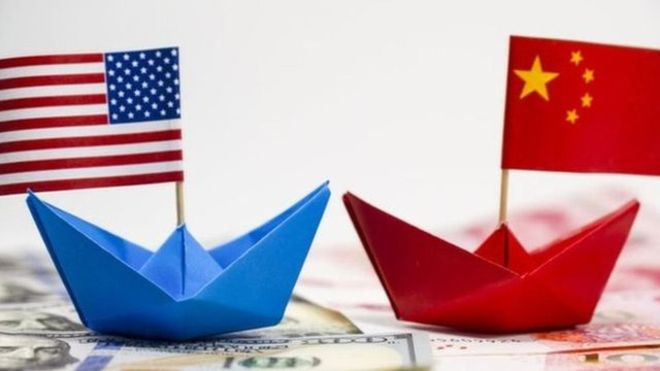
Trump’s notion of “tariffs paid by China” is based on a mistaken framework. Basic trade economics tells that the tariffs are paid by the importer, not exporter. In fact, the hiked tariffs on Chinese goods have been paid by U.S. importers who have passed part of the burden on to American consumers and users. According to related calculations, American firms and consumers paid additional billions of dollars in 2018 due to tariffs—as a whole, they are currently paying $810 every second. With tariff hikes on $200 billion of Chinese goods set to begin June 1 of this year, with pending additional 25 percent tariffs on $325 billion of Chinese goods, these burdens will rise considerably.
 A basic reality is that it is extremely difficult in America to find alternate supplies to replace Chinese goods. Out of the $250 billion of Chinese goods currently subject to 25 percent tariffs, for over roughly $100 billion worth the U.S. has over 50 percent import dependence on China. For example, the U.S. imported $414.03 billion of computers and electronics worldwide in 2018. Out of the total, $186.45 billion, or 45.0 percent was from China, larger than the next 8 largest supplies combined. Where could U.S. importers find alternate suppliers now? In 2018, the U.S. market for toys was $28 billion, depending largely on imports worth $18.49 billion. China accounted for 88 percent of total imports, valued at $16.32 billion. Where else can U.S. toy dealers find this kind of supply? As a result, U.S. importers, retailers and consumers have little choice but to pay a higher price. In the case of intermediate goods, the users will face a higher cost and falling profit. It is estimated that the 25 percent tariffs on $250 billion of Chinese goods will lead to $767 in additional annual costs borne by an American family of four, while further threatening 934,000 jobs. If this 25 percent is applied to the additional $325 billion of Chinese goods, the same family will pay $2000 more a year, and 2.1 million jobs might be lost. A recent study by UBS showed that the tariffs on Chinese goods will result in higher cost for U.S. retailers, while 50% of the 12,000 U.S. public retailers will close. Walmart, Macy’s, and other leading retailers have already felt the shocks.
On the Chinese supply side, U.S. multinational enterprises in China carry out 50 percent of Chinese exports to the U.S. The tariffs are also tilted to harm their interests. A recent American Chamber of Commerce member survey shows that the 74.9 percent of the respondents say that their competitiveness in China has been affected unfavorably by tariffs, with 52.1 percent respondents finding lower demand, 42.4 percent finding higher manufacturing cost and 38.2 percent finding lower sales.
 The Trump administration’s ban on Huawei is also causing phenomenal damage to the global supply chain for semi-conductor R&D, manufacturing, and application. Huawei had 13,000 suppliers worldwide in 2018, procuring $70 billion of devices and services, with $11 billion from Qualcomm and other U.S. suppliers. The leading U.S. chipmakers also have their own global supply chains. The ban has hit Huawei and forced the latter to follow Plan B — its own chips and systems — thus breaking the global supply chain and hurting America’s high-tech sector as well. China’s market accounted for a major share of the top 10 U.S. chipmakers’ worldwide sales. It varied from 80% of Skyworks Solution, 63 percent of Qualcomm, 60 percent of Qorvo, 52 percent of Broadcom, 50 percent of Micron, all way down to 23 percent of Intel. Without the massive sales revenue from the huge Chinese market, the U.S. chip giants will be in a difficult position to continue their huge inputs of R$D to maintain leadership in this global, cutting-edge technology. That’s the reason why U.S. tech stocks nosedived over the past week.
The continuous trade tensions will undoubtedly affect China’s exports, industry, jobs, and GDP growth. Meanwhile, the U.S. economy will also suffer. The U.S. economy is already showing signs of weakening. Although its GDP grew by 3.2 percent during Q1, 2019, its fundamentals — personal consumption expenditure (PCE) and private fixed investment combined, contributed only 1.09 percentage points, down from 2.20 in Q4 of 2018. The trend continued into April with retail sales down 0.2 percent and industrial production down 0.5 percent.
The world economy will also be a victim of the China-U.S. trade war. A recent IMF article found that if the hiked tariffs were to apply to all China-U.S. trade, world GDP would be cut by 0.3 percent. If trade relations continue to deteriorate, the OECD forecasts that global GDP would fall by as much as 0.7 percent, or roughly $600 billion, by 2021.
Facts will prove once again that there will be no winner from a trade war. The unilateral trade bullying by the U.S. is running into a dead end. The only way ahead is through face-to-face trade talks on the basis of WTO rules, to reach agreements equitable and beneficial to both sides, thus ending the current tension and bringing bilateral trade, as well as the world economy, back to a normal track.
Source: https://www.chinausfocus.com/